04 May 2011

more than a handful

Yesterday was the birthday of Christina Hendricks, which occasion prompted a debate on Slog (and probably other places on the internet) about whether her breasts are real.  Hendricks is currently most famous for her role as Joan Holloway on Mad Men, a show which has been continuously and effusively praised for its artifice.  She also has the dubious privilege of being the go-to centerpiece for any hand-wringing think-pieces about body image in Hollywood, being at once almost impossibly beautiful and constructed at a scale that makes her co-workers look like snappable dolls.  This generally means that discussion of her dimensions will begin in the opening paragraph of the article itself, rather than with the first comment.

It's niggled at me for a while, this question of real breasts.   The term sounds like it ought to apply to people whose tits have been altered in the digital realm, right?  Breasts which are literally imaginary.  But no, someone whose breasts are unreal is a person who's pursued surgical implantation.

Implants are a job requirement for a bunch of female professions, let's admit that up front.  Natural breasts are untidy, usually asymmetrical, and behave like sacs of fatty tissue in motion.  Women generated with reference to some kind of Platonic ideal, as befitting fantasy industry professionals, should have breasts which remain conic as their hosts bounce around and fail to age.  And so women who want to do these jobs are gently but firmly coerced into submitting to horrifying surgery.

As a society, we tend to consider implantation (as well as less aggressive forms of fantasy-conformation, e.g.) to be dishonest, immoral.  So you have vehement fights in which one party feels they are defending the honor of a beloved figure by claiming that she would never be so awful as to physically change her body for acting, while the other party believes they're performing a public service by revealing a base fraud.


The problem is that our judgement of a real person who works in the dream factory implicitly compares her to the fantasy creations she's helped present, and the real woman--however plastic she may be--is inevitably found wanting.

24 April 2011

Love Sausage and Respect the Law

I get a good amount of flak from meat-lovers about being a vegetarian who likes the taste of meat.  Most of them regard it as the height of folly to decline to eat something which is delicious, and a delusion to try and replace meat for any purpose.  And of course I find more people who are suspicious of the very idea of cooking in the meat-eating camp than among veggos, probably by necessity. 

There are more cogent arguments as well--an ethical, local meat industry is developing, and it's a lot easier to source one cut of beef than a jar of coriander if it's sustainability and cruelty to humans I'm concerned about (it is).  I don't know that vegetarianism is necessarily the most ethical choice all the time, so I try to present it rhetorically to others as a matter of personal preference (it is).  On the rare occasions I actually eat meat, it's the texture that's offputting: impossible not to think of my own body rent and flayed when I'm pulping muscle fibers between my molars. The taste, however, is very nice. 

Now, my partner and I are different kinds of vegetarian.  We both like animals and dislike the thought of eating their flesh, but for the most part he genuinely dislikes the smell and taste of cooking meat.  There are a few things he misses, though--chicken, mainly.  But when I mentioned the idea of recreating the Scottish sausage known as square slice, he perked right up.  This recipe has become one of his favorites, something we both enjoy on a roll or with tattie scones. 

This recipe, then, has at its heart a Vegan Dad recipe for sausage.  The first changes I made to it were to take it further from the Seitan O'Greatness, which I have always hated.  So paprika and nutritional yeast were out, as well as fennel seed and oregano.  For some reason I find that oregano always makes bitter sausages.  After a while the puréed beans dropped out as well.  What I had at this point was a pure wheat gluten log of variable size, prepared with soy sauce, vegetarian boullion, and sesame oil (which always has the effect of convincing my tongue I'm eating meat).  I mix some powdered ginger, garlic, and onion into the flour because they add to the meatiness without adding bulk or moisture. 

Pictured: some seitan. 
Wheat gluten, or seitan, is probably the best meat substitute out there.  Tofu never has quite the right texture, being either too soft if I prepare it or too chewy if I leave it to Asian restauranteurs, plus it's the devil to try to get spices to penetrate to its interior.  TVP only works for dishes that want mince.  Beans and mushrooms are tasty, but they usually have better uses.  Commercial meat substitutes like Quorn can be good, but usually taste like feet.  Seitan is as neutral as bread but takes flavours readily, and it can be prepared with any texture you like (boiled for juicy and soft, steamed for chewy-but-tender, baked for dense) with a minimum of effort.  If you're vegetarian and untouched by celiac disorder, you've definitely had seitan in a commercial veggie burger. 

Around this time we had developed a taste for a certain frozen meal, Aunt Bessie's vegetarian toad in the hole, consisting of a couple sausages in frozen Yorkshire pudding batter in a little tin.  I copied the spices off the back: coriander, nutmeg, thyme, sage, parsley.  I guessed at the amounts and added them to the flour, carefully omitting parsley. 

I started experimenting with other additives besides spices, mainly to cut the rubbery quality steamed seitan can have.  Grated cheese was one of the first things I tried, along with minced fried onion.  The cheese stuck to the foil and created hard little pockets in the seitan, while the onion had the opposite problem and just slid away when the log was cut.  An egg seemed to improve the texture without these downsides.  It was later, when I started making pakoras all the time, that I added a bit of gram flour, which has a distinctive flavour and makes it hold together better.  And of course I'm always looking for ways to put MSG into things, so Maggi seasoning, in both its liquid and cube forms, has been a godsend.  I decided to add TVP on a whim one day and it's been the best decision in the whole sausage-making process. 

Innovations in the mixing stages mainly had to do with the preparation of the TVP and the amount of water.  This part was a total bastard.  Eventually I stopped trying to wing it and measured everything out by weight.  As for cooking, I've not deviated very much from the standard instruction to steam for 45 minutes.

Here, then, is my favourite recipe, tested exhaustively by me.  It's quite forgiving, so I encourage you to experiment and find out what works for you. 

Seitan Square Slice
Prep time: 20 minutes
Cook time: 45 Minutes
Yield: 750 g, two good-sized sausage logs

Spice Mix
    1 teaspoon ground coriander seed
    1 teaspoon ground nutmeg
    1 teaspoon ground ginger
    1 teaspoon onion powder
    1/2 teaspoon cayenne
    1/2 teaspoon black pepper
    1/2 teaspoon garlic powder
    1/2 teaspoon thyme
    1/2 teaspoon sage
    1/2 teaspoon rosemary

    1 1/2 cup (180 g) wheat gluten
    1/4 cup (25 g) gram flour (If you can't find this, leave it out.) 

    1/2 cup/40 g soya mince/TVP
    1 tablespoon sesame oil
    1+ tablespoon butter
    2 - 3 tablespoons Maggi seasoning (or 4 cubes)
    around 1 2/3 cup/400 ml water
    1 egg

Dissolve boullion in 400 ml boiling water, then stir in TVP, butter and sesame oil, and a bit of the spice mix.  Allow to cool to a temperature that won't cook an egg before adding the egg. 

Combine remaining spice mix and flours in a dry bowl.  Turn in the cooled mince mixture and soaking liquid and stir with a fork until well-mixed.  You don't need to knead it, just make sure everything's wet.  Let it sit for a half hour or so in the fridge, then knead if you like. I tend not to, because it's pretty much like squeezing a bunch of oily meat.  The next stage is what determines the density, anyhow. 

Cut the dough into two pieces, and place each piece on a sheet of foil.  Roll up in a short fat log & steam for 45 minutes.  Let it cool until you can handle it, then pop it in the fridge.  When it's cool, it'll be sliceable and you can fry it up or use it in other dishes as you would any cooked sausage. 

Half of this recipe (one log) will fill 500 g puff pastry as sausage rolls.

23 April 2011

Introducing Comment of the Week

From now on, in order to improve the quality of my comments section, I'll be posting the best ones in a weekly roundup of the very best of the wit and wisdom of readers of this blog.  First up, this week's entry:


14 April 2011

let's pretend I have a tumblr

Lately I've been feeling a little like it was time for another of the periodic stylistic shakeups that we go through in our lives, so I started outlining the kind of themes and roles that I aspire to in my dress, based on Russell T. Davies' essay about pretending.  Davies, you may recall, is the creator of the initially warmly welcome (but later deeply mortifying) David Tennant series of Dr. Who.  [EDIT: Actually the man from that link is a different Russell Davies. My apologies for accusing him of responsibility for Love & Monsters.]

I thought I'd say a bit about the things I pretend from day to day.  A couple of sartorial constraints inform my choice of fantasy roles: I like to keep a lot covered (if only technically); I tend to wear browns, greens, and golds; I like flat-soled, lace-up boots and long coats; and I'm quite messy and disorganized.  And I want to be desirable--not necessarily desired, but maybe like an acquired taste.

Hippie
In truth, I am a bit of a hippie--I'm pacifistic, left-leaning, and my standards of personal hygeine are relaxed.  Only the passage of years and the development of the internet prevent me from really joining any kind of social movement.  "Hippie" as a style, though, covers a lot of ground.  Let's say it's round wire-frame glasses, flowing cotton prints, Indian influences, hair, and sandals.

Witch
My first association with a witch these days is Anthy from Revolutionary Girl Utena.  Anthy is Ishtar, re-interpreted as a devil in a newer patriarchal myth structure, but to my mind a witch isn't so much a force of nature (a la S6 Willow) as a woman who leverages a bit more personal power and fearsomeness than would generally be considered acceptable to get what she wants (a la Granny Weatherwax).  I find this image of the unregenerate scary spinster to be somewhat romantic.  So: Fluevog witch boots, black dirndl skirts abbreviated to the low calf, that whole 19th-century librarian vibe.

Amy Pond
The newest Dr. Who makes the next-newest Dr. Who look shameful and silly.  One of many reasons for that is the character of Amy Pond, who is some kind of goddamn sexual tyrannosaur.  Did you see the Comic Relief special?  The contents of Amy's panties nearly caused her men to become permanently lost in time and space.  That's not even mentioning the power of Pond's crack or her Pandorica Box.  On account of being so fucking foxy, Pond basically clomps about in a man's shirt or sweater, a short skirt, colored nail polish, and Converse.  Like the 80s with flat hair. 

Flapper
The meaning of this iconography, like any of the sexualised roles I've listed, is fraught.  There's the romance of the sexual revolutionaries: Louise Brooks, Zora Neale Hurston, Josephine Baker, Tallulah Bankhead--but all these women were subjected to terrible abuse and exploitation because of their sex. The twenties was this period of incredible sexual objectification and subjectification of women, not unlike today.  Unlike today, the silhouette is boyish instead of hyperfeminine: dropped waist, longish skirts; tight hats with little to no hair visible; sculpted-heel mary-janes or t-straps.

Pre-Raphaelite
Another artistic/fashion movement which was about glorifying and exploiting sexy women in equal measure.  Long cotton-lawn gowns or tunics, tight sleeves.  Velvet if you absolutely must. 

Gunne Sax Girl
It's a sort of 1970s interpretation of the Laura Ingalls Wilder look, with lace and calico aplenty.  Prairie Underground (aside from having the perfect name) is currently producing some fine pieces in this idiom (albeit not in calico).  Occasionally Free People as well.  I can't quite afford either.

memento mori
A bunch of my fashion life has been spent orbiting goth--trying to dress as near as I can without falling in.  It's worth interrogating what it is about goth I find cool, and what it is I find embarrassing.  Goth is a look which is all about details, proportions, lines, with colour taken out of the equation entirely.  For that reason, it's a good place to start a journey into fashion.  And because of that, there's something adolescent and unsophisticated about it, as well as retro in the mortifying way that anything from your early high school years can be.  What I think of goth as being is all about D-rings, but what I want it to be is distressed Victoriana. 

Daria
Sometimes, you just need to look like you're Not Trying.  You can't do the big shop in all your finery.  That's when Daria is my fashion icon.  I hardly need to say, but the look is prescription glasses, longish skirts, sturdy low boots, and sensible outerwear. 

Kabuki
This would be David Mack's Kabuki, the complex pre-Alias tale of a cyberpunk agent's psychological journey.  I used to be a Japanophile, but now Japan and I are just good friends.  Similarly, I used to regard cyberpunk as a dystopian future, rather than the dystopian present and/or a dystopian retro 80s style.  Still, there's a goodly amount of this retro-future-present in my day-to-day style: think Black Milk. Shiny tights, sinuous cyber seams, Japanese influences.

Elf
My elf aesthetic is all about practical gear for the forest, made from the forest.  Legolas or Link.  Pixie hoodies, ragged-edge jersey skirts, pocket belts.

Snake

Snake?

SNAAAAAAKE!
Like Naked Snake and The Boss, I'm about having a camo index of 98% while still sporting military and Red Commie influences. 

Wonder Woman pin-up
This one has very little to do with the rest, but it's been relevant to my life since I moved to Scotland and am trying to live here as an American.  When I'm out and around, I want to be a cheerful, helpful, 1940s American in a smart uniform handing out Marshall Plan candy bars, not Ugly American Neoliberalist.  Coincidentally (perhaps) Wonder Woman is the MAC theme this spring.  There's an absolute wealth of 1940s retro style about, you're probably familiar enough with it.

I feel like I'm honing in on what I like and why, as a result of this exercise. There's a militaristic/anti-militaristic thread, a sort of natural or environmental theme, and the idea of death and decay.  Also anything with a nipped waist.

17 March 2011

You're Doing Gender Wrong

I enjoy watching pop videos, I guess.  I'll certainly watch them for hours until I've had my fill.  Sometimes I even like the songs.  But mainly I enjoy watching brief linguistic and visual spectacles on the Semiotics Channel.  Take Mike Posner--if you listen to his lyrics, he just sounds like a classically-trained date rapist.  Classically-trained in date rape, I mean, not music.  But the videos for his odious songs are great!  "Cooler Than Me" has him stealing sunglasses off hipsters and looking into different film universes through them, and in "Please Don't Go" the emotional pain of a breakup causes the world to fragment and artifact around Posner like a badly-streamed video.  And every week produces a new guilded turd of similar caliber. 

Generally these days UK pop videos are fashion shows whose central themes alternate between a kind of Babestation Lite and personal affirmations that you are, in fact, okay to just be yourself, even if maybe you don't look and/or fuck like the video people.  So basically music television has become women's magazines, with all the conflicting messages about women's roles that that implies.  I'm open to the idea that young women may be in need of someone to tell them that becoming the world's most lifelike Realdoll is only one of the many things they can aspire to, of course.  I'm just not sure that message is best delivered by a writhing professional dancer with no skirt or trousers.

One style of video I have come to find especially grating is the specific claim, made over and over again, that women are in fact just as good as men and can achieve anything they want.  This was a brave sentiment in 1961; the fact that it's still in heavy rotation in 2011 would seem to imply that it hasn't really soaked in, despite the very different material conditions of first-world women these days.  These songs--Jessie J's "Do It Like A Dude" is the one in current rotation, but previously we had Alexandra Burke's "Broken Heels", a couple entries in the genre from Beyonce, and basically Pink's entire oeuvre--they appear to stem from a sense of inadequacy at not being male, a kind of "penis envy", if I may coin a phrase.  And the answer in the videoverse is to do what men do, but sexier. 

This approach misses out one of the major conceptual gains of the feminist movement, aside from how it got pretty much everyone to agree that there was some historical point at which women were getting a raw deal (currently debates tend to rage about whether we should be locating this point in the past or the present).  The gain I'm referring to is the capacity to question the gender binary.  Rather than attempting to slavishly duplicate men's lives, only with killer heels and bouncing a baby on the hip, we could use feminist intellectual tools to stand back and ask whether the mass of men have it so good today that women ought to expend their energy on catching up. 

Also of note: I am apparently so straight these days, or Jessie J's hoodie-playsuit and wacky gurning antics are so terrible, that I didn't notice that the backing dancers for her number are largely delicious-looking Afro-Carribbean butches.  J, much like Lady Gaga or myself, identifies as bisexual, so I guess I'm meant to feel some kind of solidarity.  I don't.  Also they keep mentioning that she has a heart condition.  The phrase "save your breath" springs to mind.

03 March 2011

A RACE PUN

Is fashion the most racist industry operating today, you guys?  It's hard to think of another one where racism is so vertically-integrated, from globalist-racist textile manufacture to elitist-racist high fashion, to aesthetic-racist beauty standards in magazines. 

All these want talking about in a serious way, but high fashion is a particularly interesting case because it has a special quality, which I'll term "hipster racism".  Hipster racism is that style of racism which stems from the belief that through personal sophistication and irony you have transcended racism, and that henceforth no interpretation of your actions as racist can be valid.  This posture need not be informed by any kind of self-reflection or critical knowledge, just a belief that you can't do wrong if you mean well (or mean nothing).  The hipster racist knows that he is not a racist in his heart, because he is nothing in his heart, a valueless, empty point from which explorations can be launched.  Thus he frees himself to use racist language or imagery in the name of freaking out the squares. 


Avant-garde fashion is, by definition, obsessed with being shocking and unfamiliar, in exploring the heterotopia.  But in an information-dense environment, getting your shock from something that's new is very difficult, and so fashion often goes instead to the well of the socially-unacceptable.  So we get rotating collections of anthropological curiosities, sexual outrages, political bogeymen, obscene wealth inequity, the homeless, addict chic, grotesques. The atrocity is aestheticized and monetized.  And if you got upset, you had fallen for the hipster's trap: Gotcha!  You were holding something sacred, weren't you!  Thinking something was important, when in fact everything is arbitrary and nihilistic!  LAME.

All this is why I'm a just a little bit surprised that Dior shitcanned Galliano, rather than commissioning him to create a fall collection inspired by the legacy of Hugo Boss.

03 February 2011

Weighing in on Dickwolves

My background: I've been reading Penny Arcade since 1999, I've been reading feminist blogs since the invention of blogs, I am intimately familiar with the way internet arguments escalate, and I have a sense of humor.  My take, which you should understand is the correct take from what a fucking expert I am on all these topics, is that PA made a perfectly appropriate rape joke which no one ought to have objected to, and then a funny comic mocking the concept of rape culture, and then a series of increasingly swinish moves, followed by an absolutely stellar apologyPretty much everyone else has behaved execrably. 

Out-of-context criticism is absolutely endemic to feminist blogging, and I think it's because expressing solidarity for rape victims outweighs pretty much any other concern including accuracy and fairness.  This is a value feminists have: if you asked most feminist bloggers what motivates them to blog, "because somewhere, a woman is being forced to have sex against her will" is going to be high on the list.

But qualities of the crime of rape are variable and resist conforming into an overarching social narrative of cause and effect, whether this narrative is "rape culture causes rape" or "women's rape claims are strategically-motivated".  Proponents of each narrative have their own shibboleths and very little patience for views or data that fit their narratives badly.  And why would they display patience?  Either there's a world of women whose lives have been destroyed by rape, or a world of men whose lives have been destroyed by false accusation--in either case, the appropriate response to this terrifying world of arbitrary injustice is outrage and activism. 

My personal, meaningless opinion is that there are probably numerically more rape victims than falsely-accused rapists in the Western world, but it would certainly be easy to receive the opposite impression.  False rape accusations have inherently longer news cycles, for example, and tend to leave believe-the-victim feminists looking credulous.  Also, my high-school sex-ed teacher has by now taught generations of young men that a woman whose lips have touched even a single drop of liquor will be fully supported by society and the legal establishment in railroading any young men who foolishly have sex with her to federal pound-me-in-the-ass prison.

I suppose reviewing rape conviction rates from reality would have conveyed the impression that you could do quite a lot of rapes without fear of prosecution, and so I see why she presented this nugget of men's mythology instead--still, it joins the pinpricked-condom and half in undergirding a worldview where relationships with women are a threat.  And the complementary worldview in which men are a kind of deadly animal who mainly abuse, rape, stalk, and discriminate against women is, of course, prevalent in its own circles. 

Now, on the internet, these ideologies are taken up by people whose knowledge of the nuances of their apologia vastly outweigh their experience with, e.g. the mechanics of sex, and so everything is really angry and stupid and broad.  In the case of feminist blogging, I've seen this translate into a practice of defending the notional traumatized rape victim at all costs (for example by tagging up every fucking post with "trigger warning"), even against actual rape survivors who, after all, are women who continue to live and crack wise and have idiosyncratic opinions even if the rhetoric we use tends to present them as broken or no longer fully human ("lives destroyed" earlier in this post, for instance).  For the video gamer, it is probably fairly difficult to transition suddenly to the feminist version of a term ("nonconsensual sex") which is in ubiquitous use in his subculture as a synonym for "defeat soundly", and in general use as something more like "sex obtained at knife-point, by a psychotic stranger, from a jogger".  The gulf between definitions, not to mention the existence of complete assholes on various sides, makes some kind of conciliation between ideologies a seeming impossibility. 

I'm not sure that I can bring all this together to some kind of conclusion.  I'm not sure anyone can.  I'd like to see everyone treating the person glimpsed through the screen like they were sitting beside them, but I don't exactly follow this precept in my own online conversation, and I am a bit of a dick IRL besides.  And I'd like to see fewer rapes and, I guess, fewer false accusations of rape.  I suppose I can do worse than conclude by quoting Tycho: "Go, and rape no more."

25 January 2011

Letting The Side Down

Increasingly I've come to regard my decision to call myself a feminist as being similar to my earlier decision to call myself a lesbian when I knew I was strongly attracted to men as well as women.  Calling myself a lesbian was a personal, political choice: an attempt to manage other people's impressions of me and a prescription for myself as a sexual radical.  But it was essentially dishonest, and so it was not only problematic for me personally but harmful to the sexual identity I was trying to establish solidarity with--what was the lesson of my love life but that dykes just need the right man to come around? 

I think feminism is super important of course, and the legal, social, and political equality between genders it aspires to are fundamental human justice issues that are far from resolved in even the most progressive circles of even the most privileged areas.  I'm incredibly grateful to my feminist forebears, who ensured that I wouldn't be compelled to whelp live young if I didn't want to and could go to university and all that.  And it gives me pause to even consider dissociating myself from an important social justice movement that has fallen on hard times. 

But I get exasperated with the unfalsifiable doctrine that wherever there are men and women, women must be getting the worst of it.  I get mad whenever "men" is used as a synonym for "patriarchy".  I get offended when media representations of white women are treated with greater seriousness than the actual lives of black and brown ones.  I get irritated whenever I see the implication that the advancement of women consists of getting them to catch up to men, and that men's lives are a fixed measure by which everyone ought to be judged.  I can't subscribe to the idea of a zero-sum game between one half of humanity and the other, and I don't feel that I'm different enough from penis-havers to automatically side with my sisters against my brothers.  And, lordy loo, I'm tired of having that one argument about rape.  

It's not just that my knee-jerk reaction in any situation is to also consider a male perspective before coming to a snap judgment.  I have selfish reasons as well.  I'm tired of how I react emotionally to mischaracterizations of feminism, feelings which seem distressingly near to patriotism or sports fanaticism.  I'm tired of dealing with the fallout from a 60-year disinformation campaign anytime I want to convey to someone what I believe generally.

What I want is a word that doesn't imply that I hate sex and jokes and men and domesticity, but which ideally implies that I hate God.  I want to go back to what I knew was the right term for myself the first time I read it as a child: humanist.  Secular humanist if you're nasty.  I want to define myself as pro-human and resolve to be in solidarity with humans. I know it's very white-privilege of me, but I just want my affiliations and opinions to be by choice rather than by default.

18 January 2011

My beloved, let's get down to business

Can it really be so?  Have I actually decided I have something to add to a discussion of that hyperinflated term, empowerment?  Well, yes, I'm afraid that time has come.  Strap in. 

What put me over the edge this time was watching Music, Money, and Hip Hop Honeys--which I dearly hope will have the distinction of being the only show produced by the BBC to feature a presenter asking a sexual assault victim to explain how her clothes influence rapists and jurors.  What happens in the show is, one of the women (who refer to themselves as 'video girls') gets quite bubbly and animated when she puts on revealing clothing, so the presenter concludes that, far from feeling exploited and unhappy and used while performing sexually, some women find it empowering

Then the presenter discovers that most women performing in videos don't get paid, and that they have shockingly unrealistic expectations that they are about to be 'discovered' while gyrating, and that being so discovered would make them super-rich.  She concludes that, while some video girls may feel empowered, the power actually rests with the people making all the decisions that affect their lives, and that this power relationship is not substantially affected by their gyration. 

That seems to cover the ways I generally see "empowerment" used in discussion.  So what I want is to tease out some of the meanings and assumptions when different people talk about empowerment.  I made a chart. 


As Twisty classically pointed out, the term has been co-opted by advertisers, tied firmly into the ideals of consumption.  At some point, "empowerment" was decoupled from the actual substance of power in capitalist society, namely the ownership of money and property, which is handy because open discussions of wealth do not benefit capital.  So the main way empowerment's used today is to describe feelings

Now, I am sick to death of empowerment discourse which is about personal feelings and not substantive measures of social power (i.e. money, i.e. redistributing money more evenly among existing humans, i.e. people pissing and moaning about the status quo but if you try and change it suddenly you're a communist).  Personal feelings pay for jack shit. 

Moreover, it seems that people who want to talk about feelings of empowerment are happy to imply that individual empowerment is simply collective empowerment at a smaller scale.  Individual empowerment is plainly not the secret to collective empowerment: I may gain a great deal of personal power by marrying a billionaire, but that does fuck-all for the rights of any group I purport to belong to.

What also tends to happen, as is very much the case in Hip Hop Honeys and in Twisty's worldview, is that empowerment then becomes the disempowered individual's responsibility, neatly removing oppression from the equation.  Anyone who comes to the table pre-empowered--whether by an accident of birth, lucrative work, or bald calumny--will be treated as though power is their birthright, while anyone trying to get somebody's boot off his face will have to prove both faultless and meritorious to be granted the right to occupy the ground he's being crushed into.

Mostly, though, "empowerment" is used to talk about women and sex.  What kind of sex would empower women?  What kinds of acts would sexually empowered women get up to?  What positions would be most empowering for them?  Would it be more or less empowering if the women were very attractive and young?  Would adding additional young attractive women to a sex act make it more empowering?  These questions and so many more like them have been discussed in tedious detail in the media for some reason. 

The position of third-wave feminists, if I may generalize, has tended to be that THEY are deeply afraid of a woman's pleasure, and as such every orgasm amounts to sticking it to The Man, even when you obtain it quite the other way around.  But this association of pleasure with power is problematic.

One of the themes of this blog is that pleasure is, at best, limited in its capacity to change power relationships: there's a lot of pleasure and peace in complying with society's plans for your ilk.  And unlike Homo Economicus, we often do things to get along, or to impress a lady, or to be sociable, or to have self-respect, which may not garner us or our identity-politics group greater social clout.  Making empowerment a stand-alone measure of whether an action is morally positive collapses a bunch of relevant factors into a black-and-white caricature of human lives, emotions, and social relationships, which I guess explains why it's so widely used.  

10 December 2010

Viva La Dainty

On the occasion of the let's-say-40th anniversary of these songs, and the let's-say-four-day dieversary of someone asserting that, based on the content of my blog, I would probably be right into shaving my face (!?), I feel like I ought to clear up a couple things about feminism.

Feminism is not just women getting to do what men do.  The implicit assumption behind that idea is that what men do--men's work, men's preferences, men's pastimes, men's rights and responsibilities--are the real, genuine human things, so when women do them, they will have achieved complete personhood.  That this is such an easy mistake for feminists and non-feminists alike to make testifies to how strong the idea that women aren't properly people remains, even in this era of lady policemen and men returning home in the evenings.

Now, the other assumption implicit in the discourse of feminists-wish-they-were-men is that men's activities are more desirable in addition to being more authentically human, which is also pretty wrong.  There's a number of (particularly upper-class white Western) traditional female activities which are great fun, such as baking.  You can identify these activities by whether there's an army of men clamoring to redefine them as masculine and deep and life-affirming and meaningful--currently no one is gassing on about how folding laundry is an art and a science, for instance.

Conversely, there are many areas of life where men have drawn the short straw, though I'm pretty sure I'm in danger of losing my F'membership card for saying so.  Criminal prosecution is one I've discussed previously, but things like, oh, trusting you can get the benefit of the doubt about whether you're a sex criminal when you're adjacent to a child, or not having to scrape a blade or series of blades across your vulnerable face all the time, these could reasonably be described as female privileges.

But one is discouraged from making (or ceding) this point in an argument, I guess because it encourages fellows to think that everything already works out to be square in the end, and so the status quo is jim dandy.  All I'll say about this aggressive, dare I say masculinist rhetorical posture is that maximising the points you score in arguments is by no means a foolproof way of winning souls to your side.

That said, I surely would like to grow a real beard one of these days.

03 December 2010

On Trifles

The problem with humans is that we have a really poor sense of scale.  We have great imaginations and an excellent ability to organize and work socially, so we made things that were too big to see the ends of, things that would last beyond our lifetimes.  We also made things too small to be manipulated by our hands, and too many to imagine the act of counting, and then we allowed a bunch of those things to fly up into the atmosphere and start warming the climate by two to six degrees.  Here too is the problem of scale: two to six degrees sounds quite trivial as a change in external temperature (though by all means try it inside your body and see how that strikes you) and any idea of the effects of that change on the almost infinitely complex global weather system is simply too big to hold in a head.


Now, dealing with shit we can't really comprehend is not like some kind of a product of the modern age; it's always been the case.  The new thing is that now, the stuff we don't understand, we made ourselves.  What we've mainly done about the problem of misunderstanding is create complex heuristics, cognitive fallacies, and general coping mechanisms for getting us by day to day in the world we complicated. 

Often, this just boils down to shifting the blame.  A big systemic snarl that we would hesitate even to begin to approach working out because of how embedded in our lives are in the reproduction of that system (let's say, the inhumane practices of factory farming) can be safely substituted with a manageable but ultimately trivial example in which we have little stake (say, the production of foie gras). 

I'm talking here about cooking fires.  People, typically rural people, in India and the rest of Asia and Africa, burn animal dung, wood, or coal to cook their food, and this creates a certain amount of smoke which goes in the air and contributes to various things including climate change and poor respiratory health.  The extent to which cooking fire smoke contributes to poor respiratory health is non-trivial; prolonged smoke inhalation demonstrably causes excess deaths, and as we're talking about 3 billion people whose households use solid-fuel cooking fires, this is a lot of deaths.  The extent to which cooking fire smoke contributes to climate change is, of course, disputed, but to appeal to the scientific consensus, it's probably around twenty percent of the global emission of black carbon, half as much as either diesel engines or forest fires. My best guess from looking at the data is that cooking smoke might account for up to five percent of total anthropogenic global warming, but as many of the aerosols produced by cooking fires are atmospheric coolants as well, it's hard to say.  

So, obviously, what we see is a global push to build [to sell] a better stove under the banner of fighting climate change, with health concerns an afterthought.  Besides the misapprehension of the scale of the problem--both the health problem and the contribution to climate change--there are other proximate causes for why we live in a world where trivial things are taken seriously and serious things are trivialized.  To fat warm Western audiences, climate change is still scary in a sexy way, like a serial killer, rather than scary in a deadening, heartbreaking way, like cancer.  And of course descriptions of new tech are more exciting than exhortations to be more austere.*  And then there's feminism. 

When I said that it was "people" who burn solid fuel on cooking stoves, I ought to have said that enough of those people are women as to cause asperity in your interlocutor if you were to mention in conversation that some of the members of this group were also men.  In fact, let me mention at this point that I figure I am broadly in favor of doing away with that kind of gender-neutral language in discussions of real-world populations that skew heavily to one side or the other, on the grounds that it encourages assumptions of gender neutrality where none exist--let's make the cutoff, say, 85%.  So we would have said "the people in Congress" before the 2010 elections, but "the men of Congress" after, for example.

Returning to the subject of cooking fires--the whole thing just puts me in mind of Ruth Schwartz Cowan's tremendous writing on how developments in domestic technology changed expectations for women's lives, leading to the second shift and all that.  Western women have been through the change from solid-fuel-burning stoves to electric or gas ranges; it was accompanied by the construction of infrastructure to support a power grid and natural gas lines into people's homes.  This stove stuff is pretty much an attempt to deliver the endpoint without that worryingly complicated "progress of society" project in the middle there.  While I have my own reservations about, you know, society, I find that mildly distasteful, much like the idea that I'd have to hear about how it relates to climate change in order to give a shit about a large-scale public health project.  I really want to be appealed to for my fellow-feeling for other humans (woman and child humans! the easiest humans to feel sympathy towards!) rather than a climate change rationale which is at once more self-interested and more bullshit.


*Usually.  Austerity and self-mortification also have their proponents, such as fitness fanatics, or vegans.  Is that unfair to vegans?  I was just reminded of how much I hated cooking out of Isa Chandra Moskowitz's recipe books, is why I ask.  Obviously I get most of my fake meat and a fair amount of my chili recipes from vegans, so I don't really buy the party line where vegan cuisine is bland and unappealing, but for fuck's sake, you'd never learn that cooking out of Vegan With A Vengeance.  And Bragg's Liquid Aminos is a terrible glutamator, it tastes like fucking tamari. 

12 November 2010

white lines only separate me from me

It's a bit more complicated here.  I've been studying the urban, academically and experientially--finding that balance between self-expression and space-invasion.  I decided to start out with a monochrome palette, which turned out to be an excellent decision. 

Stripes and plaids are the planned city, the grid, the ruled.  Animal prints are the organic city, the element of the unexpected in interacting with a thousand strangers a day. 

This would be paired each day with the Sartorialist's famous "pop of colo(u)r", usually yellow because I reject the bizarre notion that it's "hard to wear" and it's not associated with ongoing regional feuds.

It was not at all long before I slipped back into greens and earth tones, though, let me tell you.  It's hard to get excited about wearing black in a European city.  I also can't be fucked with wearing the prevailing styles of women my age in the area: short shorts with opaque tights, shemaghs, Superdry.  Instead I find I'm most comfortable when I look just a little off in a clearly intentional way.

08 September 2010

On the 'ormones

I don't think I should be president.  My reasons for this are various, with the most important being my W-esque disregard for the work and knowledge that should go into holding down that particular job, but the one I expect to receive the most opprobrium for is that I believe I am hormonally unsuited.  For two days a month, I vacillate between full-body depression and self-righteous belligerence.  It's not that I have no moods at other times, but this pattern is undeniable, reproducible.  I could set my watch by it if my watch had a 27-day round.

Now, I take this feature of my corporeal existence into account in my life, such as determining if I am "really sad" or "really angry" by doing some quick sums on my fingers.  Moreover, I don't make a big stink if my partner does likewise, just as I don't decry him for using the word "cunt" to describe a maleficent person.  I consider these reasonable actions, and he grants me a like leniency to inquire solicitously as to whether his organ has strangled the flow of blood oxygen to his brain, or to describe a fatuous person as a total glans. 

But I suffer some guilt for not finding it inappropriate to allow others to consider my hormonal equilibrium, in case my own actions in my personal relationships cause all women everywhere to be perceived as unserious.  I don't even want to suggest the appearance of appearing to suggest that other women experience these symptoms, in case I seem to be saying women are basket cases. 

This is a style of guilt that my political sympathies have prepared me exquisitely for: combining "the personal is political" with the categorical imperative is a good way to have a lot of people regard you as a bit of a downer.  But let me tell you, the very second I hit menopause and get a real work ethic, I'm gonna put on some pearls, strip down to my sports bra because suddenly it's just really warm all the time, and run for president of whatever country I am currently in, or think I could feasibly run.  I don't care what one, really.  Namibia, Haiti, America, whatever.

04 September 2010

goddess sizes available at no extra cost

I'm a bit paranoid, now--the catalog for dippy neopagan fucktarts, The Pyramid Collection, has a paisley-print article of clothing on every page.  Is this pattern now associated with moon-addled cat-fanciers, rather than LSD-addled George Harrison-fanciers?  I object strenuously. 

02 September 2010

Mannequins with Kill Appeal

"It only got a 30?!  You're shitting me."
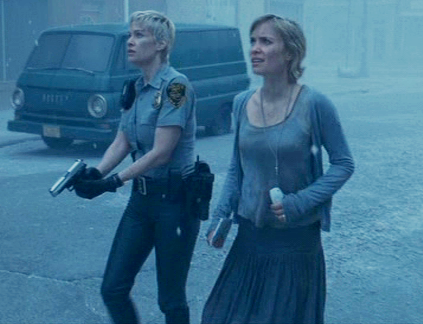
There's nothing for it: I've got to stump for the redemption of the film version of Silent Hill.  This is a movie, and I can't stress enough how unusual this is for me, where I had put it on in the background while I gazed into the internet but then found myself more and more drawn to the film and actually put the internet to one side altogether so I could watch it closely.  After it finished, I returned online again to look up the reviews, which I vaguely recalled being bad.  I was wrong: the reviews of this movie eviscerated it.  They are literally worse than Gothika.

I don't know if it had been a disappointing summer and all the critics were hot and angry or what, but there are far more deserving targets that received an indulgent pass while Silent Hill was getting its neck stomped.  I daresay there was an aspect of revenge in it: TriStar refused advance screenings, to mitigate an expected poor response, and critics clearly jumped at the chance to punish this behavior.  Horror is not the genre to work in if you're hung up on critical acclaim in any case, but when 28 Weeks Later, Shadow of the Vampire, and THX 1138 get scores in the 70s on Metacritic while Ravenous, Final Destination, and Saw have scores in the 40s, some metric other than quality of filmmaking is clearly being drawn on to evaluate them. 

I must say, first, that I have never played through a Silent Hill game, because they are scary and I get scared.  I can't, therefore, relate to some people's experience of the film as a betrayal of the franchise, comparing it against the film that should be there.  I have the luxury of only being able to evaluate what is there.

I NEED AN ADULT
I don't mean to argue that Silent Hill is a very good film, heavens no.  I'm quite comfortable losing that argument.  It just has much to recommend it and is, though this is faint praise indeed, a standout among video game adaptations.  The critical perspective I draw on which rewards me richly when I watch Silent Hill is a feminist critique, something that's still fairly thin on the ground in movie review circles.  It's very much a women's picture, if such a thing still exists: all of the characters save those inserted at the behest of execs are women; the horror is that classically feminist style, body horror; it doesn't use women's suffering primarily to titillate a presumed male gazer, as Gothika does; and, as in Aliens, it's not so much big dumb guns as motherhood that saves the day.  As far as I'm aware, no marketing to a specifically female demo was attempted: the trailers just about reproduce Sean Bean's role in full, the way the marketing for Scream was cut to suggest that Drew Barrymore survived the credits. 

The storyline is a regular ghost one, revenge/justice for a female victim of patriarchal violence and social ostracism, here with heavyhanded religious overtones that do little besides absolve the viewer of responsibility for the mistreatment of women unless they're a member of a Christosatanic cult.  The town and its horrors are explicitly manifestations of the psyche of this ur-victim.  Frankly, I'd rather have it that way than how supernatural elements are manifest in most horror films, where characters devised specifically to treat a protagonist's experiences of non-materialistic phenomena with skepticism are then punished for their disbelief with grisly death.  Here the grisly death is distributed much more impartially, which is always refreshing. 

The main thing going for Silent Hill outside of its feminism is its atmosphere.  All the exteriors are dampened in a gray-white mist where black ash falls from the sky like snow, and all the interiors have the perfect quality of urbex in a dying steeltown.  The town itself is based on the story of Centralia, Pennsylvania, but I can't help but think Roger Avery missed a trick (one of, you know, many) not writing it as a more explicit portal to hell.  The monsters have been designed from the principle of the uncanny valley, and I can't think of an instance where it's been used more pitch-perfectly, except maybe Gore Verbinksi's version of The Ring, another female-focused atmospheric horror. 

Generally the film is about mothers and daughters, which may explain the low level of sexualization experienced by the cherubic Radha Mitchell as main/final girl Rose.  Her companion for most of the film, Laurie Holden's Officer Cybil, has a cop-appropriate blatant lesbian image.  She's sexualized, but as a sleek muscular object along the lines of Robert Patrick halfway through unmelting himself in T2.  The rest of the film's sex is tied up in Pyramid Head, here a straightforward avatar of rape, and the mannequinesque nurses, whose forest of bared cleavage Rose has to cautiously pick her way through lest she be torn to ribbons.

"I would have liked more time with the cleavage nurses
and less with the religious fanatics."
Now, I think Tycho's a hundred percent correct when he says that the style of the film evokes the style of video games.  I've seen just about all the video game movies, and I've played a fair amount of survival horror, and I've seen a fuckton of cutscenes.  And the quality of cutscenes is this: they contain a lot of bad, clunky exposition, and they contain a lot of visual spectacle.  Their function is to provide a break in the action which briefly suspends the player's control in the interest of advancing the plot.  Silent Hill retains the cutsceneness closely enough that I kept feeling like I ought to be pressing X.

I don't put much stock in the idea of faithfulness as a measure of the quality of an adaptation--who wants to hear a cover of a song identical to the original, anyway?--but I have love for films that have love for their source.  Christopher Gans spent years trying to obtain the rights to Silent Hill, going so far as to create his own fan-film scored with the Silent Hill soundtrack and send it to the game's creators.  Aided by this purity of feeling, he's produced something that expresses the spirit of, if not the games themselves (for how can I judge that), the medium and the genre they spring from.  The whole idea of survival horror is that you are resource-poor and nearly powerless in a landscape designed to do you harm, and from themes to sets to characters, the movie carries this idea through wonderfully. 

I can't say I don't feel a little hurt that Silent Hill was panned so especially badly, because the symbolic language it used was so close to my own experience of feminine terror, and so keenly expressed.  When I read through mainstream reviews, I can see that none of that has come through for most reviewers, and as usual with an adaptation (especially from a devalued medium), a number of them have felt free to just make shit up to pretend familiarity with the source, like when Roger Ebert wrote that the brilliant colors of From Hell closely evoked the graphic novel.*  Fans of the game are also very angry at the ways in which it differed from the movie that happened in their minds, but that kind of bitching has been easier to write off since Watchmen.  When I look at amateur reviews, such as this one from the Bechdel Test site, though, I get the feeling that I'm not the only one who sees the value in it. 

"30, though!  What the fuck."
*Maybe I am conflating him with a different critic, but I swear that someone said this, and Ebert is a critic I have no real issue with slandering in a post that touches on gaming. 

01 September 2010

handlebars

While I'm here, I'd like to clear something up.  It's about this graphic from The Seventeen Magazine Project, describing when pigtails are "infantilizing" (i.e., undermining the expression of adult personhood) on a grown woman.  Jamie Keiles draws the distinction between infantilizing and appropriate as one of age: people out of their teens who wear pigtails are infantilized by it.  But this is wrong.

The dividing line, as you can see from her graphic, is not one of age, but of positioning on the head.  Pigtails worn below the ear are appropriate for women, while pigtails worn at or above the ear are appropriate for children.  This is not arbitrary: the whole purpose of the child's hairstyle is to prevent her from gaining easy access to her hair for the purpose of chewing it or putting mud or lye in there.  Being granted full access to one's own hair is a sign of maturity and good judgement, and that is what pigtails worn below the ear represent. 

Braids are this whole other thing that I don't feel too qualified to summarize, as I would have to touch on The Shining, native appropriations, medieval chic, Dorothy Gale, Pippi Longstocking, Helga, and vikings.  I should mention that very long hair that would be appropriate for braiding is worn mainly by older children, teens, women in their twenties, and hippie witches.

It is not necessary that everyone like everyone else

Occasionally I'm gripped with anxiety--would Nabokov have liked me?  Would he approve of how I spend my time? 

Then I think on the man a bit and relax.  No, he would not have liked me.  My thighs are huge

For my Moogle