Showing posts with label gender. Show all posts

27 October 2013

PLEASE GENDER-SWAP EVERYTHING, BECAUSE YOU DON'T KNOW HOW TERRIBLE YOU ARE YET

THE LAST OF US

The world has been overrun with zombies, as usual, and the only people who survive are rugged individuals and bands of armed mercenaries.  You play as an ordinary tween girl, El, tasked by a boy you love and trust with protecting a headstrong middle-aged man, Joely, who may hold within his delicate body the key to human salvation.  For the first half of the game, you must use your skills to keep him safe, though eventually you trust him enough to give him his own pistol and he assists you during fights.  You grow to bond with your grizzled middle-aged companion through a series of incidents, while stubbornly denying that he is nothing more to you than a surrogate for your own father.  When you are gravely injured, Joely feeds you and brings you medicine, but while he is on his own he is captured and held by the tween leader of a cannibal cult, forcing you to torture and kill the cult members you capture before mounting a raid on their compound to rescue him.  

In an innovative twist, you are briefly allowed to play as Joely (though admittedly only while El is incapacitated by injury).  The writers have gone out of their way to present the men in this game as having their own agency and goals, a laudable change from the passive wriggle-and-squeal tropes of men in video games.  Also refreshingly, no one suggests that the cannibals will abuse Joely sexually (perhaps because of his age), only that they are likely to eat him.  The violence, however, is still quite shocking: especially when you play sidekick, the animations have you stabbing girls many times in the eyes, neck, and groin to disable them.  The context cues of the game ensure that whenever El kills a girl, you know you are killing a human being with personal relationships to her sisters-in-arms, and one of the last human survivors of the apocalypse--all the more distressing because the game frequently requires you to kill all the girls in an area before you can progress.  

The visuals, writing and music in the game are all top-notch, but it suffers from being mired in a survivalist fantasy that has always been about honoring and privileging feminine skills at the expense of masculine ones.  The world of The Last of Us is designed to make technological consumerism, lawn-mowing, and high-shelf-reaching look like ridiculous, obsolete skills; mending, cooking, conflict resolution and child-rearing are the valued skillsets of the post-apocalyptic age.  It gives me pause that so many of our modern fantasies are about this type of world.  It seems to presage a generation of women dreaming about a world where they can be respected for their base animal qualities, without having to worry about male concerns or social pressures.  I shudder to think about the position of men in such a world.  

17 March 2011

You're Doing Gender Wrong

I enjoy watching pop videos, I guess.  I'll certainly watch them for hours until I've had my fill.  Sometimes I even like the songs.  But mainly I enjoy watching brief linguistic and visual spectacles on the Semiotics Channel.  Take Mike Posner--if you listen to his lyrics, he just sounds like a classically-trained date rapist.  Classically-trained in date rape, I mean, not music.  But the videos for his odious songs are great!  "Cooler Than Me" has him stealing sunglasses off hipsters and looking into different film universes through them, and in "Please Don't Go" the emotional pain of a breakup causes the world to fragment and artifact around Posner like a badly-streamed video.  And every week produces a new guilded turd of similar caliber. 

Generally these days UK pop videos are fashion shows whose central themes alternate between a kind of Babestation Lite and personal affirmations that you are, in fact, okay to just be yourself, even if maybe you don't look and/or fuck like the video people.  So basically music television has become women's magazines, with all the conflicting messages about women's roles that that implies.  I'm open to the idea that young women may be in need of someone to tell them that becoming the world's most lifelike Realdoll is only one of the many things they can aspire to, of course.  I'm just not sure that message is best delivered by a writhing professional dancer with no skirt or trousers.

One style of video I have come to find especially grating is the specific claim, made over and over again, that women are in fact just as good as men and can achieve anything they want.  This was a brave sentiment in 1961; the fact that it's still in heavy rotation in 2011 would seem to imply that it hasn't really soaked in, despite the very different material conditions of first-world women these days.  These songs--Jessie J's "Do It Like A Dude" is the one in current rotation, but previously we had Alexandra Burke's "Broken Heels", a couple entries in the genre from Beyonce, and basically Pink's entire oeuvre--they appear to stem from a sense of inadequacy at not being male, a kind of "penis envy", if I may coin a phrase.  And the answer in the videoverse is to do what men do, but sexier. 

This approach misses out one of the major conceptual gains of the feminist movement, aside from how it got pretty much everyone to agree that there was some historical point at which women were getting a raw deal (currently debates tend to rage about whether we should be locating this point in the past or the present).  The gain I'm referring to is the capacity to question the gender binary.  Rather than attempting to slavishly duplicate men's lives, only with killer heels and bouncing a baby on the hip, we could use feminist intellectual tools to stand back and ask whether the mass of men have it so good today that women ought to expend their energy on catching up. 

Also of note: I am apparently so straight these days, or Jessie J's hoodie-playsuit and wacky gurning antics are so terrible, that I didn't notice that the backing dancers for her number are largely delicious-looking Afro-Carribbean butches.  J, much like Lady Gaga or myself, identifies as bisexual, so I guess I'm meant to feel some kind of solidarity.  I don't.  Also they keep mentioning that she has a heart condition.  The phrase "save your breath" springs to mind.

25 January 2011

Letting The Side Down

Increasingly I've come to regard my decision to call myself a feminist as being similar to my earlier decision to call myself a lesbian when I knew I was strongly attracted to men as well as women.  Calling myself a lesbian was a personal, political choice: an attempt to manage other people's impressions of me and a prescription for myself as a sexual radical.  But it was essentially dishonest, and so it was not only problematic for me personally but harmful to the sexual identity I was trying to establish solidarity with--what was the lesson of my love life but that dykes just need the right man to come around? 

I think feminism is super important of course, and the legal, social, and political equality between genders it aspires to are fundamental human justice issues that are far from resolved in even the most progressive circles of even the most privileged areas.  I'm incredibly grateful to my feminist forebears, who ensured that I wouldn't be compelled to whelp live young if I didn't want to and could go to university and all that.  And it gives me pause to even consider dissociating myself from an important social justice movement that has fallen on hard times. 

But I get exasperated with the unfalsifiable doctrine that wherever there are men and women, women must be getting the worst of it.  I get mad whenever "men" is used as a synonym for "patriarchy".  I get offended when media representations of white women are treated with greater seriousness than the actual lives of black and brown ones.  I get irritated whenever I see the implication that the advancement of women consists of getting them to catch up to men, and that men's lives are a fixed measure by which everyone ought to be judged.  I can't subscribe to the idea of a zero-sum game between one half of humanity and the other, and I don't feel that I'm different enough from penis-havers to automatically side with my sisters against my brothers.  And, lordy loo, I'm tired of having that one argument about rape.  

It's not just that my knee-jerk reaction in any situation is to also consider a male perspective before coming to a snap judgment.  I have selfish reasons as well.  I'm tired of how I react emotionally to mischaracterizations of feminism, feelings which seem distressingly near to patriotism or sports fanaticism.  I'm tired of dealing with the fallout from a 60-year disinformation campaign anytime I want to convey to someone what I believe generally.

What I want is a word that doesn't imply that I hate sex and jokes and men and domesticity, but which ideally implies that I hate God.  I want to go back to what I knew was the right term for myself the first time I read it as a child: humanist.  Secular humanist if you're nasty.  I want to define myself as pro-human and resolve to be in solidarity with humans. I know it's very white-privilege of me, but I just want my affiliations and opinions to be by choice rather than by default.

18 January 2011

My beloved, let's get down to business

Can it really be so?  Have I actually decided I have something to add to a discussion of that hyperinflated term, empowerment?  Well, yes, I'm afraid that time has come.  Strap in. 

What put me over the edge this time was watching Music, Money, and Hip Hop Honeys--which I dearly hope will have the distinction of being the only show produced by the BBC to feature a presenter asking a sexual assault victim to explain how her clothes influence rapists and jurors.  What happens in the show is, one of the women (who refer to themselves as 'video girls') gets quite bubbly and animated when she puts on revealing clothing, so the presenter concludes that, far from feeling exploited and unhappy and used while performing sexually, some women find it empowering. 

Then the presenter discovers that most women performing in videos don't get paid, and that they have shockingly unrealistic expectations that they are about to be 'discovered' while gyrating, and that being so discovered would make them super-rich.  She concludes that, while some video girls may feel empowered, the power actually rests with the people making all the decisions that affect their lives, and that this power relationship is not substantially affected by their gyration. 

That seems to cover the ways I generally see "empowerment" used in discussion.  So what I want is to tease out some of the meanings and assumptions when different people talk about empowerment.  I made a chart. 


As Twisty classically pointed out, the term has been co-opted by advertisers, tied firmly into the ideals of consumption.  At some point, "empowerment" was decoupled from the actual substance of power in capitalist society, namely the ownership of money and property, which is handy because open discussions of wealth do not benefit capital.  So the main way empowerment's used today is to describe feelings. 

Now, I am sick to death of empowerment discourse which is about personal feelings and not substantive measures of social power (i.e. money, i.e. redistributing money more evenly among existing humans, i.e. people pissing and moaning about the status quo but if you try and change it suddenly you're a communist).  Personal feelings pay for jack shit. 

Moreover, it seems that people who want to talk about feelings of empowerment are happy to imply that individual empowerment is simply collective empowerment at a smaller scale.  Individual empowerment is plainly not the secret to collective empowerment: I may gain a great deal of personal power by marrying a billionaire, but that does fuck-all for the rights of any group I purport to belong to.

What also tends to happen, as is very much the case in Hip Hop Honeys and in Twisty's worldview, is that empowerment then becomes the disempowered individual's responsibility, neatly removing oppression from the equation.  Anyone who comes to the table pre-empowered--whether by an accident of birth, lucrative work, or bald calumny--will be treated as though power is their birthright, while anyone trying to get somebody's boot off his face will have to prove both faultless and meritorious to be granted the right to occupy the ground he's being crushed into.

Mostly, though, "empowerment" is used to talk about women and sex.  What kind of sex would empower women?  What kinds of acts would sexually empowered women get up to?  What positions would be most empowering for them?  Would it be more or less empowering if the women were very attractive and young?  Would adding additional young attractive women to a sex act make it more empowering?  These questions and so many more like them have been discussed in tedious detail in the media for some reason. 

The position of third-wave feminists, if I may generalize, has tended to be that THEY are deeply afraid of a woman's pleasure, and as such every orgasm amounts to sticking it to The Man, even when you obtain it quite the other way around.  But this association of pleasure with power is problematic.

One of the themes of this blog is that pleasure is, at best, limited in its capacity to change power relationships: there's a lot of pleasure and peace in complying with society's plans for your ilk.  And unlike Homo Economicus, we often do things to get along, or to impress a lady, or to be sociable, or to have self-respect, which may not garner us or our identity-politics group greater social clout.  Making empowerment a stand-alone measure of whether an action is morally positive collapses a bunch of relevant factors into a black-and-white caricature of human lives, emotions, and social relationships, which I guess explains why it's so widely used.  

10 December 2010

Viva La Dainty

On the occasion of the let's-say-40th anniversary of these songs, and the let's-say-four-day dieversary of someone asserting that, based on the content of my blog, I would probably be right into shaving my face (!?), I feel like I ought to clear up a couple things about feminism.

Feminism is not just women getting to do what men do.  The implicit assumption behind that idea is that what men do--men's work, men's preferences, men's pastimes, men's rights and responsibilities--are the real, genuine human things, so when women do them, they will have achieved complete personhood.  That this is such an easy mistake for feminists and non-feminists alike to make testifies to how strong the idea that women aren't properly people remains, even in this era of lady policemen and men returning home in the evenings.

Now, the other assumption implicit in the discourse of feminists-wish-they-were-men is that men's activities are more desirable in addition to being more authentically human, which is also pretty wrong.  There's a number of (particularly upper-class white Western) traditional female activities which are great fun, such as baking.  You can identify these activities by whether there's an army of men clamoring to redefine them as masculine and deep and life-affirming and meaningful--currently no one is gassing on about how folding laundry is an art and a science, for instance.

Conversely, there are many areas of life where men have drawn the short straw, though I'm pretty sure I'm in danger of losing my F'membership card for saying so.  Criminal prosecution is one I've discussed previously, but things like, oh, trusting you can get the benefit of the doubt about whether you're a sex criminal when you're adjacent to a child, or not having to scrape a blade or series of blades across your vulnerable face all the time, these could reasonably be described as female privileges.

But one is discouraged from making (or ceding) this point in an argument, I guess because it encourages fellows to think that everything already works out to be square in the end, and so the status quo is jim dandy.  All I'll say about this aggressive, dare I say masculinist rhetorical posture is that maximising the points you score in arguments is by no means a foolproof way of winning souls to your side.

That said, I surely would like to grow a real beard one of these days.

03 December 2010

On Trifles

The problem with humans is that we have a really poor sense of scale.  We have great imaginations and an excellent ability to organize and work socially, so we made things that were too big to see the ends of, things that would last beyond our lifetimes.  We also made things too small to be manipulated by our hands, and too many to imagine the act of counting, and then we allowed a bunch of those things to fly up into the atmosphere and start warming the climate by two to six degrees.  Here too is the problem of scale: two to six degrees sounds quite trivial as a change in external temperature (though by all means try it inside your body and see how that strikes you) and any idea of the effects of that change on the almost infinitely complex global weather system is simply too big to hold in a head.


Now, dealing with shit we can't really comprehend is not like some kind of a product of the modern age; it's always been the case.  The new thing is that now, the stuff we don't understand, we made ourselves.  What we've mainly done about the problem of misunderstanding is create complex heuristics, cognitive fallacies, and general coping mechanisms for getting us by day to day in the world we complicated. 

Often, this just boils down to shifting the blame.  A big systemic snarl that we would hesitate even to begin to approach working out because of how embedded in our lives are in the reproduction of that system (let's say, the inhumane practices of factory farming) can be safely substituted with a manageable but ultimately trivial example in which we have little stake (say, the production of foie gras). 

I'm talking here about cooking fires.  People, typically rural people, in India and the rest of Asia and Africa, burn animal dung, wood, or coal to cook their food, and this creates a certain amount of smoke which goes in the air and contributes to various things including climate change and poor respiratory health.  The extent to which cooking fire smoke contributes to poor respiratory health is non-trivial; prolonged smoke inhalation demonstrably causes excess deaths, and as we're talking about 3 billion people whose households use solid-fuel cooking fires, this is a lot of deaths.  The extent to which cooking fire smoke contributes to climate change is, of course, disputed, but to appeal to the scientific consensus, it's probably around twenty percent of the global emission of black carbon, half as much as either diesel engines or forest fires. My best guess from looking at the data is that cooking smoke might account for up to five percent of total anthropogenic global warming, but as many of the aerosols produced by cooking fires are atmospheric coolants as well, it's hard to say.  

So, obviously, what we see is a global push to build [to sell] a better stove under the banner of fighting climate change, with health concerns an afterthought.  Besides the misapprehension of the scale of the problem--both the health problem and the contribution to climate change--there are other proximate causes for why we live in a world where trivial things are taken seriously and serious things are trivialized.  To fat warm Western audiences, climate change is still scary in a sexy way, like a serial killer, rather than scary in a deadening, heartbreaking way, like cancer.  And of course descriptions of new tech are more exciting than exhortations to be more austere.*  And then there's feminism. 

When I said that it was "people" who burn solid fuel on cooking stoves, I ought to have said that enough of those people are women as to cause asperity in your interlocutor if you were to mention in conversation that some of the members of this group were also men.  In fact, let me mention at this point that I figure I am broadly in favor of doing away with that kind of gender-neutral language in discussions of real-world populations that skew heavily to one side or the other, on the grounds that it encourages assumptions of gender neutrality where none exist--let's make the cutoff, say, 85%.  So we would have said "the people in Congress" before the 2010 elections, but "the men of Congress" after, for example.

Returning to the subject of cooking fires--the whole thing just puts me in mind of Ruth Schwartz Cowan's tremendous writing on how developments in domestic technology changed expectations for women's lives, leading to the second shift and all that.  Western women have been through the change from solid-fuel-burning stoves to electric or gas ranges; it was accompanied by the construction of infrastructure to support a power grid and natural gas lines into people's homes.  This stove stuff is pretty much an attempt to deliver the endpoint without that worryingly complicated "progress of society" project in the middle there.  While I have my own reservations about, you know, society, I find that mildly distasteful, much like the idea that I'd have to hear about how it relates to climate change in order to give a shit about a large-scale public health project.  I really want to be appealed to for my fellow-feeling for other humans (woman and child humans! the easiest humans to feel sympathy towards!) rather than a climate change rationale which is at once more self-interested and more bullshit.


*Usually.  Austerity and self-mortification also have their proponents, such as fitness fanatics, or vegans.  Is that unfair to vegans?  I was just reminded of how much I hated cooking out of Isa Chandra Moskowitz's recipe books, is why I ask.  Obviously I get most of my fake meat and a fair amount of my chili recipes from vegans, so I don't really buy the party line where vegan cuisine is bland and unappealing, but for fuck's sake, you'd never learn that cooking out of Vegan With A Vengeance.  And Bragg's Liquid Aminos is a terrible glutamator, it tastes like fucking tamari. 

08 September 2010

On the 'ormones

I don't think I should be president.  My reasons for this are various, with the most important being my W-esque disregard for the work and knowledge that should go into holding down that particular job, but the one I expect to receive the most opprobrium for is that I believe I am hormonally unsuited.  For two days a month, I vacillate between full-body depression and self-righteous belligerence.  It's not that I have no moods at other times, but this pattern is undeniable, reproducible.  I could set my watch by it if my watch had a 27-day round.

Now, I take this feature of my corporeal existence into account in my life, such as determining if I am "really sad" or "really angry" by doing some quick sums on my fingers.  Moreover, I don't make a big stink if my partner does likewise, just as I don't decry him for using the word "cunt" to describe a maleficent person.  I consider these reasonable actions, and he grants me a like leniency to inquire solicitously as to whether his organ has strangled the flow of blood oxygen to his brain, or to describe a fatuous person as a total glans. 

But I suffer some guilt for not finding it inappropriate to allow others to consider my hormonal equilibrium, in case my own actions in my personal relationships cause all women everywhere to be perceived as unserious.  I don't even want to suggest the appearance of appearing to suggest that other women experience these symptoms, in case I seem to be saying women are basket cases. 

This is a style of guilt that my political sympathies have prepared me exquisitely for: combining "the personal is political" with the categorical imperative is a good way to have a lot of people regard you as a bit of a downer.  But let me tell you, the very second I hit menopause and get a real work ethic, I'm gonna put on some pearls, strip down to my sports bra because suddenly it's just really warm all the time, and run for president of whatever country I am currently in, or think I could feasibly run.  I don't care what one, really.  Namibia, Haiti, America, whatever.

02 September 2010

Mannequins with Kill Appeal

"It only got a 30?!  You're shitting me."
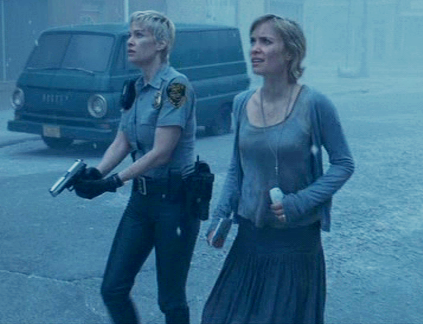
There's nothing for it: I've got to stump for the redemption of the film version of Silent Hill.  This is a movie, and I can't stress enough how unusual this is for me, where I had put it on in the background while I gazed into the internet but then found myself more and more drawn to the film and actually put the internet to one side altogether so I could watch it closely.  After it finished, I returned online again to look up the reviews, which I vaguely recalled being bad.  I was wrong: the reviews of this movie eviscerated it.  They are literally worse than Gothika.

I don't know if it had been a disappointing summer and all the critics were hot and angry or what, but there are far more deserving targets that received an indulgent pass while Silent Hill was getting its neck stomped.  I daresay there was an aspect of revenge in it: TriStar refused advance screenings, to mitigate an expected poor response, and critics clearly jumped at the chance to punish this behavior.  Horror is not the genre to work in if you're hung up on critical acclaim in any case, but when 28 Weeks Later, Shadow of the Vampire, and THX 1138 get scores in the 70s on Metacritic while Ravenous, Final Destination, and Saw have scores in the 40s, some metric other than quality of filmmaking is clearly being drawn on to evaluate them. 

I must say, first, that I have never played through a Silent Hill game, because they are scary and I get scared.  I can't, therefore, relate to some people's experience of the film as a betrayal of the franchise, comparing it against the film that should be there.  I have the luxury of only being able to evaluate what is there.

I NEED AN ADULT
I don't mean to argue that Silent Hill is a very good film, heavens no.  I'm quite comfortable losing that argument.  It just has much to recommend it and is, though this is faint praise indeed, a standout among video game adaptations.  The critical perspective I draw on which rewards me richly when I watch Silent Hill is a feminist critique, something that's still fairly thin on the ground in movie review circles.  It's very much a women's picture, if such a thing still exists: all of the characters save those inserted at the behest of execs are women; the horror is that classically feminist style, body horror; it doesn't use women's suffering primarily to titillate a presumed male gazer, as Gothika does; and, as in Aliens, it's not so much big dumb guns as motherhood that saves the day.  As far as I'm aware, no marketing to a specifically female demo was attempted: the trailers just about reproduce Sean Bean's role in full, the way the marketing for Scream was cut to suggest that Drew Barrymore survived the credits. 

The storyline is a regular ghost one, revenge/justice for a female victim of patriarchal violence and social ostracism, here with heavyhanded religious overtones that do little besides absolve the viewer of responsibility for the mistreatment of women unless they're a member of a Christosatanic cult.  The town and its horrors are explicitly manifestations of the psyche of this ur-victim.  Frankly, I'd rather have it that way than how supernatural elements are manifest in most horror films, where characters devised specifically to treat a protagonist's experiences of non-materialistic phenomena with skepticism are then punished for their disbelief with grisly death.  Here the grisly death is distributed much more impartially, which is always refreshing. 

The main thing going for Silent Hill outside of its feminism is its atmosphere.  All the exteriors are dampened in a gray-white mist where black ash falls from the sky like snow, and all the interiors have the perfect quality of urbex in a dying steeltown.  The town itself is based on the story of Centralia, Pennsylvania, but I can't help but think Roger Avery missed a trick (one of, you know, many) not writing it as a more explicit portal to hell.  The monsters have been designed from the principle of the uncanny valley, and I can't think of an instance where it's been used more pitch-perfectly, except maybe Gore Verbinksi's version of The Ring, another female-focused atmospheric horror. 

Generally the film is about mothers and daughters, which may explain the low level of sexualization experienced by the cherubic Radha Mitchell as main/final girl Rose.  Her companion for most of the film, Laurie Holden's Officer Cybil, has a cop-appropriate blatant lesbian image.  She's sexualized, but as a sleek muscular object along the lines of Robert Patrick halfway through unmelting himself in T2.  The rest of the film's sex is tied up in Pyramid Head, here a straightforward avatar of rape, and the mannequinesque nurses, whose forest of bared cleavage Rose has to cautiously pick her way through lest she be torn to ribbons.

"I would have liked more time with the cleavage nurses
and less with the religious fanatics."
Now, I think Tycho's a hundred percent correct when he says that the style of the film evokes the style of video games.  I've seen just about all the video game movies, and I've played a fair amount of survival horror, and I've seen a fuckton of cutscenes.  And the quality of cutscenes is this: they contain a lot of bad, clunky exposition, and they contain a lot of visual spectacle.  Their function is to provide a break in the action which briefly suspends the player's control in the interest of advancing the plot.  Silent Hill retains the cutsceneness closely enough that I kept feeling like I ought to be pressing X.

I don't put much stock in the idea of faithfulness as a measure of the quality of an adaptation--who wants to hear a cover of a song identical to the original, anyway?--but I have love for films that have love for their source.  Christopher Gans spent years trying to obtain the rights to Silent Hill, going so far as to create his own fan-film scored with the Silent Hill soundtrack and send it to the game's creators.  Aided by this purity of feeling, he's produced something that expresses the spirit of, if not the games themselves (for how can I judge that), the medium and the genre they spring from.  The whole idea of survival horror is that you are resource-poor and nearly powerless in a landscape designed to do you harm, and from themes to sets to characters, the movie carries this idea through wonderfully. 

I can't say I don't feel a little hurt that Silent Hill was panned so especially badly, because the symbolic language it used was so close to my own experience of feminine terror, and so keenly expressed.  When I read through mainstream reviews, I can see that none of that has come through for most reviewers, and as usual with an adaptation (especially from a devalued medium), a number of them have felt free to just make shit up to pretend familiarity with the source, like when Roger Ebert wrote that the brilliant colors of From Hell closely evoked the graphic novel.*  Fans of the game are also very angry at the ways in which it differed from the movie that happened in their minds, but that kind of bitching has been easier to write off since Watchmen.  When I look at amateur reviews, such as this one from the Bechdel Test site, though, I get the feeling that I'm not the only one who sees the value in it. 

"30, though!  What the fuck."
*Maybe I am conflating him with a different critic, but I swear that someone said this, and Ebert is a critic I have no real issue with slandering in a post that touches on gaming. 

25 August 2010

As my friend whom I’ll call Sam says, “I’ve dated women with everything from an A-cup to a D"

Every day or so I spend on the internet, I come across one of the five to six hundred iterations of this article, on what women can stop doing to attract men.  It's always written from the perspective of someone whose sole claim to authority on the subject is that they are a guy, which mystifies me: can there really be women who have no male friends or acquaintances that would bloviate rapturously on what they believe would most please a man?  In any case, all these articles boil down to a variation on the sentiment, "It's important that you be well-groomed, but I want you to stop spending time on grooming so that we can have more time to do things I like, such as touching a boob."  There is some kind of disconnect in these men's brains between cause (grooming) and effect (groomed) that probably also makes them Libertarians. 

Anyway, if men would like to take my big-ass gametes as qualification to tell them what all women think, and if they would like to stop doing something which completely fails to impress me, they could stop pretending to give a shit about sports.  I know, some women may claim to enjoy sports or like the company of men who do, but because they disagree with me, they're unrepresentative.  I suspicion that all the women who say they like sports don't really but are just pretending in order to attract men.  I am myself constitutionally incapable of enjoying sports and generally distrust the motives of anyone who does, but that shouldn't affect how totally right I am about this. 

Men, I think, only profess to like sports because if they don't other men will relentlessly hound them with accusations of homosexuality.  In men, I judge liking a thing which is inherently unlikeable to impress men to be understandable, and pitiable in a sympathetic way.  In women, I judge liking that unlikeable thing to impress men to be a contemptible betrayal of one's authentic self.  This double standard is my stake in the ground, now let's pretend it's the Daily Show and go to the part of the tape where I contradict myself utterly. 

So, video games.  I am strongly attracted to video games because for the past twenty years they've had the exciting, disreputable sheen of The Next New Media, with regularly-scheduled moral panics providing a rebellious charge to liking them.  And, if I'm honest, because the boys I always liked always like gaming--the weird boys, the boys with the D&D books and the graph paper and anime porn.  Though they could stop with the anime porn, frankly.

Now, I am fucking shit at video games.  I have terrible reaction time and I am emotionally devastated if I can't beat a level on the third or fourth try.  I can't play against people because I get upset if they win too much and worried about what they think of me if I win too much, and if I have any difficulty at all I'll be fighting the urge to wander off and never finish. 

It's clear to me that games, even more than films or books (but maybe not as much as music), serve as mile markers in the lives of the people who love them, bound up in memories of where and who they were when they played Metal Gear Solid or Bioshock or Chuckie Egg.  Nostalgia is such a powerful force in the industry because gaming is so experiential: when you play something that touches you, you're really stitching it into your life in the strongest way possible without actually parachuting into the jungle and fighting Russians while feeding on tree frogs.  And my favorite thing is to hear people articulating their memories, to know what they love and why it animates them.  But ideally without reference to the infield fly rule.

18 August 2010

I got arms that long to hold you

Where I'm going I'm pretty sure I'll still need eyes to see, but--sadly? I don't know--I doubt I'll need a lot of the other body parts I collected over the years. A number of the more portable ones are already packed away, but those pictured here must remain in my room or, in the case of the torso, be stealthily abandoned in a distant public area after dark.

I decorated these when I was younger and worse and had fewer
Sharpies, so, you know, sorry you had to look at them.
Glass head appears courtesy of Pier 1.
Barbie leg at left for scale.
A keychain and...not sure why that has a safety pin. Punk rock!
Some human hair.
My closet.

Okay, so why do I have these? I'm more into skulls these days, but I think it had to do with wanting to seem dangerous, yet clever and sexy, like a serial killer. I never felt like other people regarded middle-class pacifists as sufficiently dangerous for my taste. But I also surmise that my motivations had something to do with the suggestion in Killing Us Softly that women are often depicted as disembodied parts rather than full people.

I saw Killing Us Softly 3: Son of Softly once in a college sociology class, and once in a college feminism class, and once before that in a context I don't remember.  It begins with Jean Kilbourne relating how she, a simple young woman working in the advertising department of a medical journal, happened to invent the idea of "taking ads seriously" in the 1970s when she started pinning sexist ads up on a big board in her home and then asking her friends to assist her in rendering a critical reading.  I can't really fault her for promoting a DIY approach to forming a personal philosophy, but I can't help but be irritated by anyone advancing the intuitive, anecdotal I-just-know approach to scholarship that is her stock and trade.  Anyway, she goes on to claim that violence against women is "widespread and increasing", which would have been quite a bold thing to say in 1999 since it would have so drastically contradicted so many reports and studies discussing the dropping crime rates at the time.  I imagine it's just a consequence of not updating your slideshow that often. 

Kilbourne argues, over clips of leggy women voguing as cameras follow them at a low angle, that "over and over again, just one part of the body is used to sell products, which is of course the most dehumanizing thing you can do to someone. Not only is she a thing, but just one part of that thing is focused on." Leaving aside a whole bunch of begging the question there, to what extent is this true, and to what extent does it matter? I guess after giving the whole thing around ten years' thought, I'll go with a) to some degree and b) somewhat. Close-up framing is basically an inevitability in image creation since, oh, ever, but at the very least since Birth of a Nation. And the way advertising works--the constant, increasingly sophisticated attempts to create, shape, and respond to consumer demands while always showing them something memorable--any part of the body that's fair game to show is going to be continually refigured and repurposed to make it new. That would probably be well and good if making a display of the perfected aspects of women's bodies weren't of such special interest to this society at the same historical moment when we seem to have reached the maximum tolerable level of equality and autonomy for the distaff and have started trying to shout back the tide.

But to what extent does this sort of compartmentalization and objectification affect women's self-conception, thereby insidiously undermining efforts at equality? When asking a question like this--essentially "is this a cultural construction or are women just like that?"--it's useful to be able to look to men. Sure enough, men are reported to experience great distress when the value of their bodies is abstracted to the dimensions of a single appendage. That level of distress, however, doesn't seem to have greatly affected their overall performance as a gender. It really seems to have more to do with, you know, choice and opportunity and all that, than whether they're humiliated in advertisements.  Because boy, are they ever.

The control of images and words is overly weighted as a tool for equality, I think, because words and pictures are fun to blether about. Controlling them seems quite easy compared to enacting policies to lessen the gulf between rich and poor, which would probably do the most good for everyone involved. But it isn't easy. Words and pictures are always going to break out of restrictions, because that's just the way people do. And I daresay, if political energy is indeed a finite resource (who knows, right? But I bet I wouldn't be so interested in the study of images if it weren't for Kilbourne) that it could be better spent studying to organize than studying to adbust. I understand, however, that my opinion may lose some of its authority when you see that I bought human hair.

Lain will be accompanying me to grad school if I can just
figure out a way to remove her head.

16 August 2010

Instructive Failures

 I am something of an academic by nature, and it is to this I attribute my (apparently unusual) high tolerance for didactic cinema.  I'm not saying I could sit through Crash without yelling at the screen or anything, but I stuck with Studio 60 long after the show had dropped all pretense of being anything other than Aaron Sorkin's Chew On That Hour.  Sorkin is that entertainer who pulls a rabbit out of a hat in a novel and entertaining way, and then when the audience clamors "Amazing!  More tricks!" just pulls the same rabbit out of some slightly different hats over and over again until everyone has left.  It's not an uncommon mode for artists, and the first rabbit you see can be really something.

I never watched Sorkin's most beloved creation, The West Wing, but I feel like I understand the kind of catharsis it provided to progressives rendered catatonic by the actions of the Bush administration to have a shadow cabinet play out their Al Gore fantasies.  I'd seen Sports Night and enjoyed as much of it as I understood when it was first on, years before my partner told me he was really getting into Studio 60.   We watched almost all of the doomed first season together.  It's probably telling that I've seen the show up to the big nineleveny cliffhanger in which a main character's life hung in the balance, and have not yet felt a need to see whether she lives or dies.

What finally killed my willingness to indulge Studio 60's oratory, that I might learn something about how American topical sketch comedy shows are formed, was a dawning awareness of a certain tendency it had in common with a lot of modern screenwriting.  It was what instantly put me off Fringe and of course Heroes: a compulsive need to subvert audience expectations that turns pathological.  The fall of Heroes between its first and fourth season is...well, already this post is of extreme length, and I could go on essentially indefinitely about what went wrong there, breaking it down fractally, shot by shot.  But basically what killed Heroes was trying to surprise the fan community by refuting their expectations, especially when they expected a sensical, meaningful plot. 

For Fringe, the expectations it was subverting were those created by The X-Files, which in 1993 was itself subverting an audience expectation by creating a skeptical and science-minded female character (who was still always wrong) and an intuitive and credulous man who seemed to assemble his near-unfailingly correct interpretations of weird events by the same word-association method the Bat-Man uses to solve the Riddler's clues.  Fringe, then, seemed to be based on the assumption that audiences would find it daring to see a credulous and intuitive female investigator paired with a skeptical and science-minded man, and would not correctly identify their subverted subversion as a tired stereotype.

The subversion I remember best from Studio 60 is when Evangelical funnywoman Harriet is misquoted in an interview in a way that suggests she believes that homosexuality is uniquely sinful, after which she is violently attacked by some large angry gays.  You may recall this particular story--in which god-fearing men and women innocently expressing a nuanced version of their beliefs are physically threatened by the same depraved sex perverts who control the media and twist around their words to suggest that not wanting gays to marry is somehow an expression of hate or fear--from the recent Supreme Court case on whether petition signatures from Washington state's Referendum 71 would remain public record or become secret, in the interest of protecting people who feared that their public expression of bigotry might cost them something.  (The court ruled 8-1 that the plaintiffs' wish to keep their terrible opinions between themselves and their legislature did not override well-established laws promoting civic transparency. The plaintiffs continued plainting after this, wishing the court to note how unfair it was that they had no chance of proving how fellow co-signers of this, their attempt to protect the solemn gravity of marriage by keeping it safe from people who really really want to get married while reserving it for people who have been cooling on the whole idea for 40 years, might be targeted with a similar level of harassment to two men who want to hold hands.)  So I found that to be a somewhat irresponsible bit of writing, in that, like most of Harriet's character on the show, it felt intended to pander to and soothe the ruffled feathers of a moderate Christian audience I'm pretty sure was never watching.

The second notable subversion attempt I wanted to talk about is one I misremembered, which came up during a discussion with my partner of blogospheric rumblings on whether Olivia Munn's disastrous Daily Show appearances were yet another manifestation of The Daily Show's "woman problem".  The female problem in question is one that should be familiar to students of television: shows, but especially comedies, have trouble attracting and keeping female writers even when they are actively seeking them out, let alone when they aren't.  My partner mentioned that Studio 60 had had a subplot involving a lawsuit by a former writer, Karen, alleging that the writers' room on the show-within-a-show was no more than a boys' club and that she had been fired for being insufficiently like the chick in the men's mags who just, you know, likes totally normal, pudgy guys and wants to wear push-up bras and Daisy Dukes and get beaten at video games.  I recalled that the episode contained a sequence in which Karen's lawyer asks around the show to find out why people believe she was fired, and to a man, they answer "Because she wasn't funny."

This did indeed happen, but it's worth noting that none of the characters expressing this opinion were actually contemporaries of the fired writress.  Also, when I went to look at more detailed summaries of the episode, I noticed that the final word on the matter came from one of the executive producers reading out the actual text of the complaint, which begins to make Karen look like she might not be talking completely out of her ass.  The content of the scene is based on a sexual harassment lawsuit filed against the producers of Friends by shitcanned stenographer Amaani Lyle, where besides discussion of David Schwimmer's orientation and Courtney Cox's fuckability, she alleges that the writers had collaboratively constructed a parallel Friends in which Joey was a serial rapist.  Regrettably, this is not the plot of Joey.  The complaint in Studio 60 relates an extensive public discussion of various ways the male writers would fain fuck Harriet--on an altar, with a crucifix, in Pat Robertson's mouth, etc.--which would itself constitute excellent grounds for a religious discrimination lawsuit.  The executive producer is of course deeply troubled by this, because Harriet is his woman.  So let's call Sorkin's opinion on the frivolity of high-profile sexual harassment lawsuits--because I think it is pretty safe to say that the words coming out of his characters' mouths are intended primarily to advance his opinion--ambiguous.

It sounds like I'm saying I disliked the show for not toeing my particular party line, and maybe that's the case, though I wouldn't be watching much TV if I couldn't put my politics to one side in the interest of entertaining myself.  I think it's more that I don't really believe Sorkin thinks that scary gays will bash Christians or that bitches be trippin', but that he is condescending to the imagined prejudices of his audience in order to feel he has leeway to make his point.  I'm not exactly bucking the conventional wisdom here: all reviews I've read of Studio 60 involve some variation on calling it condescending.  But, you know, it's not awful to be condescended to if you're genuinely ignorant on a subject and are interested in getting a quick grounding.  What Sorkin managed by talking down to me on subjects I know something about, and by not seeming to mind if he was getting them all wrong, is just to make me doubt his credibility on anything I thought I might be learning from him.  The only times I've ever minded a lecture are when I know I have a hell of a lot better handle on something than the guy who's trying to explain it to me in very small words.

12 August 2010

Platonic Ideals

Last night was the second time I saw this romantic comedy I like very much, and which I liked as much on the second viewing, I Love You, Man.  So this would be about the seventh time I've seen a romantic comedy I liked, counting rewatchings of Addicted To Love and The Truth About Cats & Dogs.  When I watch a film, the first thing I'm watching is always the writing, and this is about the most expertly written romantic comedy I've seen.  What I mainly have against romantic comedies is the ubiquitous device where what comes between the obviously fated lovers is a misunderstanding that, once the characters actually speak to each other to clarify it, leaves them happily in each other's arms, which annoys me with the implication that they are complete idiots.  I Love You, Man avoids this by having the characters' real actions hurt and grate on each other, but then have them apologise and forgive after an appropriate amount of time.  The way the characters get gradually revealed to each other and to us just makes me really happy.  I suppose I'm especially susceptible to films like this since I have both a great interest in how lonely people are supposed to make friends and how relationships function between men of the same gender. 

There's problems with it too, of course, ones typical of the--UGH--"bromantic" genre: of a cast of intricately bequirked characters, the only one lacking development is the girlfriend, played by the winning (if preppily-clad) Rashida Murphy, whose only apparent characteristic is that while she seems to adore processing issues to help along her fiancée's plot development, she has never engaged and was never planning to engage with him about what he likes in bed.  The guyfriend (played by 250 pounds of Jason Segel in a 180-pound bag), on the other hand, with his...well, I was going to list his character-revealing quirks but they are vast like the ocean--he's fucking fascinated with Paul Rudd's sex life, intent on improving it.  And subsequently intent on introducing breakup-inducing tension into Rudd's romantic relationship. 

Why I bring it up, though, is that I think in the future this will be regarded as an early polyamory film, the same way The Kids Are All Right won't.  The movie treats the relationship between the male leads as nominally nonsexual, but they do tongue each other, and get involved in each others' sex lives in advisory capacities, and the ultimate scene is the two of them repeatedly confessing love for each other before the film zooms out and fades on the straight wedding.  The primary partner's encouragement of the second relationship and subsequent jealousy, the secondary partner's passive-aggression, and all the characters' insistence throughout the film that "what I said to you was supposed to stay between you and me!"--it's textbook. 

While I'm no polyamorist--surely one of the major perks of getting into a longterm relationship is you can stop dating--I think the ideals of communicative honesty, trust, respect and mutual accommodation that polyamory, queer, and BDSM types have built to support nonstandard relationship structures are laudable and should be studied by anyone who wants to be with another person.  And I think that some variation on the relationship structures they're hammering out today will be the future if the arc of the future keeps bending towards sexual tolerance and egalitarianism, which is why it was the subject of the second Futurama movie.  But I could be wrong, and it could be that people are always gonna be more willing to live in some rickety (or "time-honored") prefab structure than go through all the honesty and processing and work it would take to plan and build something to suit themselves.

11 August 2010

Blood & Salt

The things that managed to interest me about Salt (a largely unremarkable entry into what, to me, will henceforth always be the Jack Bauer genre) are, unsurprisingly, gender issues, courtesy of Angelina Jolie.  By the IMDB's account, Tom Cruise was originally attached to play the part of Evelyn Salt, but backed out when he discovered the film would portray him married to the Marxist from The Counterfeiters.  The part was subsequently rewritten for Angelina Jolie, which seems to have mainly involved changing the pronouns.  I approve!  Jolie is a fine actor and high in essential charisma, though I always wish she'd get back up to her Gia weight because right now the way her robust head is set on that tiny, ropey neck makes her look like a spoon.* 

But imagining each scene as it would play with a man of equal height also allowed me to imagine I might be observing something about the culture, something I could later use as a jumping off point for gassing about gender equality in a blog entry.  So: I believe that Tom Cruise's torture scene would have been longer, and I believe the discussion I had in the car driving home wouldn't have been about whether crashing a van into a police car would have snapped Cruise neatly in twain.  I believe, too, that I can back up my belief with comparisons to pretty much all the other 24-style action thrillers, which depict with loving detail the suffering of their leads.  To keep this fairly brief let's just take it as read. 

It would be usual to follow this line down a regular feminist argument: women are presented in media as weaker than men in their ability to withstand pain, when in fact blah blah childbirth, oorah.  I feel that, besides being the kind of bullshit that social conservatives use to argue that men and women may have their separate spheres, but each is of equal importance and equally fulfilling, this argument is just missing something.  I can't truly blame anyone for missing it, because, pardon me for getting all Morpheus here, we're soaking in it.   What we've become blind to by its constant naturalization in basically all media is violence against men, aka "violence". 

Men are constantly situated in media as the ideal subjects of violence.  I'm not saying there's not also an agenda running in some Hollywood films of punish-the-feminine; that would be a silly claim.  But we perceive depicted violence against women as particularly brutal against a backdrop of near-constant violence against men.  Salt, for example, kills somewhere between twenty and a hundred men in her film and I think kicks a lady cop in the chest, but the villain is unforgivably evil because he shoots a female attaché after shooting a dozen equally defenseless dudes. 

A conversation about how men have it kind of rough is uncommon in feminist circles, though I know so many women with interests in genders outside their own.  Primarily, if one brings up the fact that men are more likely to be the victims of violence than women and that this is normalized and celebrated in media, it is viewed as an attempt to undercut and equate violent victimization of men with dehumanization and control of women, drawing attention away from this important subject.  Fair enough, but who's going to stand against systematic, socially-approved gender-based violence if not feminists? 

Now, I enjoy very much the privilege of being considered unhittable.  I've only been punched once, in the fourth grade, and I doubt there are many men who can say the same.  But it seems to me that the protection I enjoy from being considered an appropriate target for violence isn't based on a recognition of my human dignity, but rather on a societal calculation of the value of protecting me as a resource.  Men's value is calculated differently, and so they are naturalized as the targets and perpetrators of violence.  While they are overrepresented as CEOs and politicians, so too are they overrepresented as the homeless, prisoners, and soldiers.  The Expendables, as opposed to Precious.

So one of the things we could do to increase gender equity in the affluent West is increase assaults, robberies, and carjackings against women, and of course by women.  We could get comfortable with the idea of more women being homeless and more women being exploded and shot fighting for us.  We could accept that whatever men are experiencing is the gold standard for what should be considered human, and strive always toward getting women to experience the same shit.  Or we could acknowledge that men are disproportionately the victims of violent crime, stop viewing and portraying that as perfectly reasonable, and try to, you know, decrease violence, particularly state-sponsored violence, against them, just like we campaign and rail against violence toward women.  That's the option I like. 

* It is wrong to focus on women's appearances in this manner.  Terribly, terribly wrong.

21 July 2010

On Women in the Sciences

Years ago, I attended a panel on Women in Science for which the prompt was the shitstorm stirred up by Harvard president Lawrence Summers remarking that tenure appointments of female science and mathematics professors at Harvard had probably declined steadily throughout his tenure because of a) babbys, and b) innate differences in the sciencey parts of women's brains. The panel was made up of three female scientists and one male scientist; the audience was...well, I went to a panel later in the same conference titled A Woman's Right To Jimmy Choos and the demographic composition was roughly the same.

The male scientist was the first speaker, and looking distinctly uncomfortable, he explained that while he in no wise agreed with Summers' assessment, he felt it would be a disservice to the panel format to have only panelists who were in total agreement, and so he would advance what he felt was the best defense of the innate differences theory he could muster. Basically, that defense was: it was utterly ridiculous to dismiss discrimination and socialization as factors in women's low representation in science jobs in the manner Summers had been presented as doing, but to treat the idea of innate differences between men and women as an already-settled question was unscientific, and more research should always be conducted.

The female speakers all declined to touch directly on the subject of Summers' remarks, and I had the distinct impression of them scooting their chairs ever so slightly away from the first speaker.  Instead the female scientists focused on their personal narratives as girls and then women interested in science. All noted that they had been routinely mistaken for secretaries by male colleagues of all ages, and all bemoaned the difficulty of finding mentors who people would decline to spread rumors they were fucking. The second speaker, who seemed most interested in talking about female scientists in the aggregate and least interested in talking about her journey, mentioned the case of Ben A. Barres. Barres, an M.I.T.-educated neuroscientist, transitioned from female to male in his thirties, and recalled, for example, overhearing colleagues discussing his work commenting "He's such a better researcher than his sister Barbara!"

Then came the Q&A portion of the panel, where people could get up and query the panelists. To a woman, it consisted of people who wanted to unleash a blistering torrent of invective at Larry Summers and were not reluctant to use the unhappy male speaker as a surrogate, whatever his views. After three or four of these the moderator opted to restrict commenters to only caustic screeds which could be phrased in the form of a question, and it was around then that I decided it would be a better use of my time to wander off.

15 July 2010

On The Perils Of Representation


 I borrowed this PSA poster--yes, let's say borrowed, I am definitely one day going to return to that university and replace that poster--from a bathroom stall at a university, because I think it is a poetic bit of propaganda.  It allows for a fair depth of deconstruction, which I like in an image.  Before reading on, I suggest you familiarize yourself with the ideas of literary and film criticism, particularly the concept of a "reading" of a text.  I don't want to have to delete a bunch of comments going "you're wrong because that's not what the creators meant" like I did when I said Disney's The Little Mermaid was about interracial relationships. 

So: what are our elements?  Black hand, money, white hand, disease.  I say that this will extend to metaphors about black people, white people, commerce, and all varieties of malady.  So: White imperialists come to black nations with the promise of enriching commerce, but instead blight them with poverty and disease.  Or a corruption affects all commerce, poisoning black and white alike.  Or the green bugs are not pathologies, but the "germ" of new life, created by the flow of currency.  Or money is germy.  Or black people are germy.  Note that this last (and maybe the first if we're being picky) is racist.  Indeed, there are several racist readings of the text of this image, even without getting into the positioning with respect to the viewer and who is accepting what and so on. 

Let us consider two hypothetical images like this, one with two black hands, and one with two white hands.  Because race, like most human categories, has a marked and an unmarked (or default) status, only one will appear to the casual observer (particularly a casual observer from a default category) to be dealing directly with race.  This problem is a Known Issue with race.  What are some of the proposed solutions (i.e. ways to avoid being called racist while portraying non-whites in media) and what are the possible drawbacks to each one?

• Always ignore race
Maybe a noble thought, but the problem is that people can't actually do this.  Largely it boils down to ignoring the fact that everyone in your portrayal is white due to the consequences of some unstated assumptions.

• Harp on race constantly
Annoying and exhausting for anti-racists, racists, and people who feel that not much caring puts them more in the former group than the latter.  Leads to films like Crash. 

 • Be black
Wait, hear me out.  In media contexts, people from marginalized groups tend to be granted more latitude to express opinions only on the matter of their specific group's relation to the mainstream, on the grounds that people from marked categories are likelier to be expert on these subjects than people from default categories.   More comprehensibly, on tv, black people get to talk shit about black and white people and no one except racists or academics or racist academics will really take exception.  Of course, there is a firmly-established political culture dedicated to catering to upset racists, so this is still a bit dicey.  Other possible drawbacks: society won't just let you become black for some bullshit reason.  And, I don't know if this is true, but I heard somewhere that there are disadvantages to being black in America that outweigh the notional pleasure of knowing that you could still potentially be on tv if you use the word "nigger" extensively. 

 • Tokenism/Diversity Checklist casting
Regardless of their level of racial savvy, pretty much everyone can tell if you're doing this.  The impulses that drive this style of character creation (a bid for universal appeal) usually also preclude fully humanizing any characters, and because the desire to have "one of each kind" of cast member need not spring from any actual political awareness, it's easy for it to be accompanied by a bunch of racial stereotypes or for Ma-Ti to not really have any good powers. 

 • Use only white people
Don't...don't actually do this, as a strategy or otherwise.  Besides being patently inhumane, people do eventually notice, and then you either have to justify it (questionable) or change (difficult).   

 • Stop depicting humans
This can backfire pretty easily.  Certain suites of characteristics you might wish to portray with a non-human character, George Lucas, are already associated with poisonous racial stereotypes and whether or not you meant them that way everyone will assume the worst.  Also, people generally need to be involved at some stage, whether in voice, character design, general aesthetic, writing, or premise, and any of these people can have unexamined racial biases or ignorance that make their way into the final product. 

 • Alien casting method
Maybe you know the story, but the scriptwriters for Alien supposedly specified that all the characters were "unisex", and encouraged the casting of actors of whatever gender to play any of them, except Ripley, who was definitely going to be a dude.  While a favored technique of mine, this can only work in situations where race and gender are genuinely interchangeable, and as such is limited in its capacity to tell stories in which these are meaningful dynamics. 

 • God, this is tricky.  What would Solomon do?  

 Oh goddamit it Solomon.

13 July 2010

Today in unintended reactions to pharmacy promotional material

Keep your beak out of my birth control pills, Denny, you creepy leering ghoul.

03 July 2010

On Wearing Not-Makeup

"Women shouldn't wear makeup because they look better without it" is right up there on the list of sentiments that keep my eyes rolling like a Kit-Cat clock with "Women shouldn't shave their pubes because I have a deep concern for feminism, and not at all because I long to press my face into a dense bush and reckon I have the authority to order women to comport themselves in a manner befitting my circa 1972 sexual fantasies."

Women have shit going on in their lives that doesn't revolve around you.  If you find yourself saying something along these lines, be aware that you sound like a tool, exactly as much as if you were saying that you should have the right not to be subjected to women's awful bare faces. 

There's a number of rationales people have for feeling like they can demand the paint come off.  Many express outrage or discomfort with the idea of a falsified face, tinged with varying degrees of jealousy or misogyny.  Some cite political or aesthetic objections to beauty standards that women feel compelled to approximate in their makeup.  Many of these, I've learned, habitually confuse people wearing natural-look makeup with people who don't wear makeup, and so believe that the most heavy-handed applications are representative.  A few simply have impossibly high standards for the skill involved in application, and so believe people shouldn't even try if they're not making up at a professional level. 

I also sense, in some of men's objections, a feeling of being unnerved that someone has gone to additional trouble to look pleasing, when they are strongly discouraged from reciprocating in kind.  Makeup seems to make these guys feel like more is expected from them, an implicit contract they didn't have the chance to agree to.

Others, idiots, appear to believe that attention to one's appearance precludes the ability to think about any other subject, and that such attention signals unbecoming pride in a body one is meant to keep from distracting others.  I feel pretty justified in calling this opinion moronic because I used to hold it before I gave the matter even a second's thought. 

Look, If makeup didn't make you look better, for whatever value of "better" is currently en vogue, it would die out.  Structural functionalism comin' atcha.  But I feel makeup has more to recommend it than mere improvement.  It can transform you, not just into your best you, but into any you you can communicate.  Applying makeup well requires a steady hand and good observation, both of yourself and of the qualities of what you want to create.  And I believe that clear self-reflection, tempered with self-love, is fundamental to maximizing what you get out of the brief few years you spend being an alive human.

Everyone should get to wear makeup.  It's what separates us from the animals (if that's your bag).  At the same time, though it irritates me to have to make this explicit, no one ought to be forced or coerced into wearing makeup (at any moment, in any particular fashion) to keep their employment or permission to act as part of society.  Okay, except maybe screen actors. 

If you'd still like to make a feminist-styled argument that pigments applied to the body deserve to be chucked in the dustbin of history (perhaps because you reify some concept of "natural"), let me give you a quick pointer.  You're going to find a great many feminists curiously unmoved by a precis whose assumptions concerning what would increase social justice hinge on making women look better.

02 July 2010

In Every Color And Flavor Too

While I bear men no particular ill will, I do have a reflexive dislike of movies about them.  That is to say, not films in which a character is subject to a central premise or situation, and because there's no compelling reason for that character to be female, he's been defaulted to male.  I'm talking about films where the lead is presented in the preview as a captivatingly, intoxicatingly normal-man male regular-shmoe guy fellow and the film centers around the delightful and meaningful quirks of his precious character.  Usually he is either recently single or becomes so in the opening scenes, so that what little plot there is can center around him getting some girl.  I've seen a ton of these, of course: it's a major genre.  Another one comes down the pike every six hours or so, and it annoys me the same way the latest "His DAUGHTER...is KIDNAPPED by BAD MANS.  now HE...has to BREAK...ALL the LAWS...and EVERYONE'S FACE...TO GET HER BACK" film does.

Let's see if we can get a list going here.

Young guys:
  • The Graduate
  • Youth In Revolt
  • Adventureland
  • Garden State
  • Superbad (though many Judd Apatow films have this "behold, Man!" quality, constantly remarked on by lazy pundits writing on the theme of What's Wrong With The Youth, they often also have interesting premises)

Middle-aged guys (the largest section! this is the age and gender of hollywood screenwriters! "Write what you know", after all!):
  • Punch Drunk Love
  • Lost In Translation (unusual for spending a great deal of time on the inner life of gorgeous uggo Scarlett Johansson, but compensating for this slight originality by being utterly wretched)
  • Greenburg
  • Funny People
  • Sideways
  • Manhattan
  • Annie Hall
  • Marty
  • American Splendor
  • American Beauty
  • Downfall
  • Stranger Than Fiction (A meta example! In this film, which you are to see if you read this, the mancharacter is a creation (?) of female novelist Emma Thompson, which puts a spin on the whole genre that I think necessitates me rewatching it for a new reading)

Old guys:
  • The Wrestler (Debatable. This one has a premise: the dude used to be a wrestler.  If I include it, shouldn't I include Rocky, and Taxi Driver, and Bad Lieutenant, and The Machinist, and The Pianist, and The Professional, and The Driver, and The Horse Whisperer, &c; &c;)
  • As Good As It Gets
  • About Schmidt

These movies vary wildly in quality, like films in any genre, and my initial suspicion is often easily overcome.  My skepticism is based on an idea I have that films dealing with men's personal crises, their "journeys" to use the term of bullshit art, are widely viewed as more serious and more innately worthy than the same films would be if they had female leads and female-specific crises.

I'm sure such films are kicking around somewhere...let's see...oh, Alice Doesn't Live Here Anymore, that's a good example...Waitress and the whole raft of cute preganancy movies that came up with it, Juno, Knocked Up...Sherrybaby, if anyone's heard of that.  I'm sure a variety of Meryl Streep movies must focus on how she is aging and what that must be like.  And of course romantic comedies often play as "normal lady with issues that mean she can't land a man" films.  And there's Lifetime. 

Come to think of it, I reflexively dislike Manproblem Cinema more when it centers around women.  It just doesn't come up as often.  Man-films, with their seriousness, can attract a lot more talent and money and subtlety at every stage of production, and it shows.  Moreover, for myself the idea of being older, and male, and somewhat more free, is at the very least escapist.  Women's pictures are more like psychological horror.

30 June 2010

I AM POD, THE GREAT AND TERRIBLE

Being, I guess, somewhat dumb, I'm a big watcher of BBC3, though not if there's anything on BBC4.  So it was that, around 2 AM, I would come across Snog Marry Avoid, a makeover show whose title is loosely based on the playground/road trip exercise Fuck Marry Kill.  The premise of the show, as introduced by former Atomic Kitten and increasingly tan person Jenny Frost, is that British women are over-fond of makeup and under-fond of clothing, and with the help of a sassy computer -- bear with me here -- she will reintroduce them to their "natural beauty."  The phrase "natural beauty" is constantly repeated on the show, but poorly defined.  Removing a quarter-inch thick layer of tarry foundation is arguably moving towards natural, but putting a thinner layer on afterward is contradictory; "natural" seems to be synonymous with "brunette" regardless of the color of hair growing from someone's head; and many of these (mostly very young) women come to the show already in a state of unusual naturalness with regards to dress. 

The course of each makeover runs just so: A test subject / victim / contestant / FUTURE TV STAR is introduced with a 360° turn-around of her body in the clothes and makeup she selected to go on the show, angled from about knee-high.  I don't think I've seen a subject not wearing nosebleed-inducing platform stilettos.  There follows a montage showing her ludicrous fashion sense, intercut with shots of her drinking and dancing at clubs and the hours-long process of applying fake tan, false eyelashes, and hair extensions.  Hours-long processes not stressed as contemptible include hair removal, skincare, salon visits, and plastic surgery--at least half of the subjects have breast implants.  I would applaud the show for its lack of commitment to "natural beauty" when that would mean re-cutting up young women to prise out their silicone, if shows like The Swan and Extreme Makeover hadn't made the decision about whether to slice up women seem more like a matter of production costs than morality. 

After the introduction, the subject meets Jenny Frost, who displays her blinding teeth in an attempt to appear friendly.  Frost makes some neutral-to-positive comments about the subject's appearance, before asking if she is "ready to meet POD."  The subject assents, and the scene cuts to her walking into a darkened room.  With a click, a brilliant light floods the stage, lighting the entire background Frost-tooth white.  The subject looks disoriented as her pupils contract, and a sarcastically posh female voice addresses her.  "I AM POD.  WHO ARE YOU?"  The only reason to watch the show is the conceit that this voice comes from a 70s-sized sentient supercomputer whose primary directive is the promotion of "natural beauty" and whose secondary purpose is to self-righteously slag off these subjects without the distraction of possessing her / its own critiqueable body or style.  Gok Wan, take note!  Deny your humanity and embrace metal gender! 

There's two real flavors of subject on the show: women who have bought into every media-disseminated notion of what makes a woman sexually attractive to men to an outlandish degree (my temptation is to, for the sake of brevity, refer to members of this category as "whores", but this seems like a poor idea for several reasons, the most pertinent being that it strikes me as dismissive of the stylistic choices of actual sex workers); and people who I don't think will be particularly offended if I call them freaks.  Both styles of subject play their role on the show like an audition tape, either flirting and pouting at the computer or acting contemptuously too-cool for its machinations to work on them (respectively, obv.). 

POD is openly hostile and confrontational to subjects about their style of dress and makeup, using an incredulous, personally-affronted tone to berate them about their "fakery".  The show gets away with a great deal here due to its non-human host, including directly asking women if their breasts are "real" (a digression here about this question and its expected response probably deserves to be expanded into its own entry), calling them dirty, stupid, and low-class, and generally treating as stomach-churning the idea that they are making an overt public display of their sexual availability.  And that's before the hard-sell tactics start. 

Everyone is put on the back foot when a computer starts yelling at them, but the freaks tend to be slightly better versed in defending their stylistic choices than the cartoon sexpots.  I always watch in the hope that someone will offer a critique of the idea of "natural beauty", and some do, but I find them all to be pretty inarticulate about it, and to deliver their responses with the arrogance of a snotty teenager who believes she is the first one to have figured out that it's all phony, maaan.  Mostly it comes off as dull people who don't have writers spluttering vainly to come up with a way to own an opponent who has no momma.  Nonetheless, most are deeply protective of their styles. 

The theme of adding a garnish of scientific gravitas to the proceedings continues here with a survey of an undisclosed number of "members of the public"-- a public which appears to consist entirely of moderately attractive men ages 20-35, often the same six or seven men whom I expect are interns on the show -- about whether, seeing a picture of "this girl", they would choose to Snog, Marry, or Avoid her.  Typically there is also a secondary survey asking whether they think she looks like a) a sophisticated lady b) a punny joke answer or c) a filthy whore.  The subject is asked to pick what she thinks the men selected in each case, by pressing a touchscreen button which is also the inside of your television screen.  She views a selection of these men opining about her looks to a camera; they refer to her in the third person and are apparently not privy to her responses.  We the viewer, however, are privy to every emotion that flickers across her face during this time, as the show does not cut away but instead displays the men speaking in a picture-in-picture box. 

The percentages of "avoid" and "filthy whore" responses are obviously higher than the subject would like (that is the premise of the show), and it is at this low point in her estimation of herself that POD asks if she is ready to experience a jocularly and typically also insultingly named "make-under" (e.g. "spunky junkie to middle-class lass").  The subject assents and with a small fanfare is instantly transformed by means of a photocopier-style horizontal bar scanning down her body, replacing the old clothes, hair, and makeup with the new.  I don't have much to say about the content of the makeovers except that they tend to feature minidresses worn with black tights, and that all of the subjects are still wearing stripper platforms with stiletto heels, though occasionally not the ones they hobbled in on.  Another 360° turn-around, and then POD asks the subject if she is pleased.  Subjects express surprise and admiration in a manner that, if I were POD, I would instantly dismiss as utter fakery.  The eponymous survey is re-administered, men say they like the looks of this one, and "avoid" responses decrease to zero.

All the subjects possess a familiar air of arrogant desperation: the attitude of those whose foremost ambition is to be on television, and who to that end have worked and strained and struggled every day of their lives to cultivate a talent for applying to be on reality television shows.  In a highly valid survey I conducted with actual members of the public, 100% of them find viewing youths who cop this attitude to bias them towards thinking that these obvious fame-hounds deserve every bit of the humiliation they volunteer for, as well as making me, I mean them, more likely to cut the show slack for treating its contestants with cruelty.  In the interest of creating sympathy for other human beings even when they are televised, I suggest the overzealous medicalization of an ambition for fame, and the treatment of this dubious pathology with the oversubscribed addiction model. 

The subject bids POD goodbye and turns off the light before walking out and reappearing on the street, where they are met by friends, a partner, or their mother, who usually express a more sincere degree of shock and delight at the new look.  Partners, for probably obvious reasons, tend to be the least expressive of any pleasure they may experience, noting that the subject "looks good whatever you wear", but also averring that they hope she will now spend less time on her makeup.  Often a follow-up interview is conduced by Jenny Frost one month later, where she comes upon the subject during the day in a coffee shop and draws conclusions about whether the televised makeover has made a long-term difference to her clubwear.  There is a high relapse rate, probably because unlike some makeover shows, this one does not take the step of destroying the remainder of the subject's wardrobe. 

The show can knock out three of these sequences in 30 minutes, usually pairing two sexpots with one freak.  It's also puffed up with some interstitial segments in which Jenny Frost tests out DIY beauty aids.  In one frankly gobsmacking scene, Frost uses some old pressed-powder bronzer and lotion to concoct a fake tan solution, then puts her finger to her lips and says "Shh!  Don't tell POD!"  I suppose the show's overall message is something along the lines of "don't overdo it, just be genuine", but that is hard to take from a programme with a magic computer for a host. 

Snog Marry Avoid is one of that new breed of cultural products that are crafted to work on numerous levels: as serious advice for women whose beautification routines have become overwhelming; as a freakshow; as a cynical and frankly sinister co-opting of feminist messages to love the body you have; as dystopic post-industrial sci-fi; and as a parade of slim, barely dressed young women in high heels who get justly punished before they are rewarded for wanting to be good girls.  It's sickly fascinating to me for all these reasons, but after watching a dozen or so youngsters be highly defensive of their off-the-rack streetwalker costumes, I think there's an appeal of this fashion that the steamroller approach to making them "natural beauties" ignores entirely. 

There's a lot of reasons for a young person to feel frightened, anxious, and conflicted about their sexuality today, and slipping into a pre-made persona with preset responses from the alternate sex can provide some feelings of security, of being protected by your mask.  More than that, though, if you make yourself into a panto character, and someone slags you off, it becomes easier to dissociate your private, personal self from their put-downs.  It's not you they're insulting; they don't even know you.  Honestly, how could they?