Showing posts with label sex. Show all posts

17 March 2011

You're Doing Gender Wrong

I enjoy watching pop videos, I guess.  I'll certainly watch them for hours until I've had my fill.  Sometimes I even like the songs.  But mainly I enjoy watching brief linguistic and visual spectacles on the Semiotics Channel.  Take Mike Posner--if you listen to his lyrics, he just sounds like a classically-trained date rapist.  Classically-trained in date rape, I mean, not music.  But the videos for his odious songs are great!  "Cooler Than Me" has him stealing sunglasses off hipsters and looking into different film universes through them, and in "Please Don't Go" the emotional pain of a breakup causes the world to fragment and artifact around Posner like a badly-streamed video.  And every week produces a new guilded turd of similar caliber. 

Generally these days UK pop videos are fashion shows whose central themes alternate between a kind of Babestation Lite and personal affirmations that you are, in fact, okay to just be yourself, even if maybe you don't look and/or fuck like the video people.  So basically music television has become women's magazines, with all the conflicting messages about women's roles that that implies.  I'm open to the idea that young women may be in need of someone to tell them that becoming the world's most lifelike Realdoll is only one of the many things they can aspire to, of course.  I'm just not sure that message is best delivered by a writhing professional dancer with no skirt or trousers.

One style of video I have come to find especially grating is the specific claim, made over and over again, that women are in fact just as good as men and can achieve anything they want.  This was a brave sentiment in 1961; the fact that it's still in heavy rotation in 2011 would seem to imply that it hasn't really soaked in, despite the very different material conditions of first-world women these days.  These songs--Jessie J's "Do It Like A Dude" is the one in current rotation, but previously we had Alexandra Burke's "Broken Heels", a couple entries in the genre from Beyonce, and basically Pink's entire oeuvre--they appear to stem from a sense of inadequacy at not being male, a kind of "penis envy", if I may coin a phrase.  And the answer in the videoverse is to do what men do, but sexier. 

This approach misses out one of the major conceptual gains of the feminist movement, aside from how it got pretty much everyone to agree that there was some historical point at which women were getting a raw deal (currently debates tend to rage about whether we should be locating this point in the past or the present).  The gain I'm referring to is the capacity to question the gender binary.  Rather than attempting to slavishly duplicate men's lives, only with killer heels and bouncing a baby on the hip, we could use feminist intellectual tools to stand back and ask whether the mass of men have it so good today that women ought to expend their energy on catching up. 

Also of note: I am apparently so straight these days, or Jessie J's hoodie-playsuit and wacky gurning antics are so terrible, that I didn't notice that the backing dancers for her number are largely delicious-looking Afro-Carribbean butches.  J, much like Lady Gaga or myself, identifies as bisexual, so I guess I'm meant to feel some kind of solidarity.  I don't.  Also they keep mentioning that she has a heart condition.  The phrase "save your breath" springs to mind.

02 September 2010

Mannequins with Kill Appeal

"It only got a 30?!  You're shitting me."
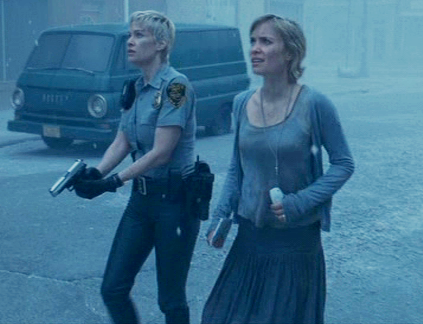
There's nothing for it: I've got to stump for the redemption of the film version of Silent Hill.  This is a movie, and I can't stress enough how unusual this is for me, where I had put it on in the background while I gazed into the internet but then found myself more and more drawn to the film and actually put the internet to one side altogether so I could watch it closely.  After it finished, I returned online again to look up the reviews, which I vaguely recalled being bad.  I was wrong: the reviews of this movie eviscerated it.  They are literally worse than Gothika.

I don't know if it had been a disappointing summer and all the critics were hot and angry or what, but there are far more deserving targets that received an indulgent pass while Silent Hill was getting its neck stomped.  I daresay there was an aspect of revenge in it: TriStar refused advance screenings, to mitigate an expected poor response, and critics clearly jumped at the chance to punish this behavior.  Horror is not the genre to work in if you're hung up on critical acclaim in any case, but when 28 Weeks Later, Shadow of the Vampire, and THX 1138 get scores in the 70s on Metacritic while Ravenous, Final Destination, and Saw have scores in the 40s, some metric other than quality of filmmaking is clearly being drawn on to evaluate them. 

I must say, first, that I have never played through a Silent Hill game, because they are scary and I get scared.  I can't, therefore, relate to some people's experience of the film as a betrayal of the franchise, comparing it against the film that should be there.  I have the luxury of only being able to evaluate what is there.

I NEED AN ADULT
I don't mean to argue that Silent Hill is a very good film, heavens no.  I'm quite comfortable losing that argument.  It just has much to recommend it and is, though this is faint praise indeed, a standout among video game adaptations.  The critical perspective I draw on which rewards me richly when I watch Silent Hill is a feminist critique, something that's still fairly thin on the ground in movie review circles.  It's very much a women's picture, if such a thing still exists: all of the characters save those inserted at the behest of execs are women; the horror is that classically feminist style, body horror; it doesn't use women's suffering primarily to titillate a presumed male gazer, as Gothika does; and, as in Aliens, it's not so much big dumb guns as motherhood that saves the day.  As far as I'm aware, no marketing to a specifically female demo was attempted: the trailers just about reproduce Sean Bean's role in full, the way the marketing for Scream was cut to suggest that Drew Barrymore survived the credits. 

The storyline is a regular ghost one, revenge/justice for a female victim of patriarchal violence and social ostracism, here with heavyhanded religious overtones that do little besides absolve the viewer of responsibility for the mistreatment of women unless they're a member of a Christosatanic cult.  The town and its horrors are explicitly manifestations of the psyche of this ur-victim.  Frankly, I'd rather have it that way than how supernatural elements are manifest in most horror films, where characters devised specifically to treat a protagonist's experiences of non-materialistic phenomena with skepticism are then punished for their disbelief with grisly death.  Here the grisly death is distributed much more impartially, which is always refreshing. 

The main thing going for Silent Hill outside of its feminism is its atmosphere.  All the exteriors are dampened in a gray-white mist where black ash falls from the sky like snow, and all the interiors have the perfect quality of urbex in a dying steeltown.  The town itself is based on the story of Centralia, Pennsylvania, but I can't help but think Roger Avery missed a trick (one of, you know, many) not writing it as a more explicit portal to hell.  The monsters have been designed from the principle of the uncanny valley, and I can't think of an instance where it's been used more pitch-perfectly, except maybe Gore Verbinksi's version of The Ring, another female-focused atmospheric horror. 

Generally the film is about mothers and daughters, which may explain the low level of sexualization experienced by the cherubic Radha Mitchell as main/final girl Rose.  Her companion for most of the film, Laurie Holden's Officer Cybil, has a cop-appropriate blatant lesbian image.  She's sexualized, but as a sleek muscular object along the lines of Robert Patrick halfway through unmelting himself in T2.  The rest of the film's sex is tied up in Pyramid Head, here a straightforward avatar of rape, and the mannequinesque nurses, whose forest of bared cleavage Rose has to cautiously pick her way through lest she be torn to ribbons.

"I would have liked more time with the cleavage nurses
and less with the religious fanatics."
Now, I think Tycho's a hundred percent correct when he says that the style of the film evokes the style of video games.  I've seen just about all the video game movies, and I've played a fair amount of survival horror, and I've seen a fuckton of cutscenes.  And the quality of cutscenes is this: they contain a lot of bad, clunky exposition, and they contain a lot of visual spectacle.  Their function is to provide a break in the action which briefly suspends the player's control in the interest of advancing the plot.  Silent Hill retains the cutsceneness closely enough that I kept feeling like I ought to be pressing X.

I don't put much stock in the idea of faithfulness as a measure of the quality of an adaptation--who wants to hear a cover of a song identical to the original, anyway?--but I have love for films that have love for their source.  Christopher Gans spent years trying to obtain the rights to Silent Hill, going so far as to create his own fan-film scored with the Silent Hill soundtrack and send it to the game's creators.  Aided by this purity of feeling, he's produced something that expresses the spirit of, if not the games themselves (for how can I judge that), the medium and the genre they spring from.  The whole idea of survival horror is that you are resource-poor and nearly powerless in a landscape designed to do you harm, and from themes to sets to characters, the movie carries this idea through wonderfully. 

I can't say I don't feel a little hurt that Silent Hill was panned so especially badly, because the symbolic language it used was so close to my own experience of feminine terror, and so keenly expressed.  When I read through mainstream reviews, I can see that none of that has come through for most reviewers, and as usual with an adaptation (especially from a devalued medium), a number of them have felt free to just make shit up to pretend familiarity with the source, like when Roger Ebert wrote that the brilliant colors of From Hell closely evoked the graphic novel.*  Fans of the game are also very angry at the ways in which it differed from the movie that happened in their minds, but that kind of bitching has been easier to write off since Watchmen.  When I look at amateur reviews, such as this one from the Bechdel Test site, though, I get the feeling that I'm not the only one who sees the value in it. 

"30, though!  What the fuck."
*Maybe I am conflating him with a different critic, but I swear that someone said this, and Ebert is a critic I have no real issue with slandering in a post that touches on gaming. 

26 August 2010

I <3 Lairds

More now in my series on cosplay you can do quickly if you happen to have been shoring up your collection of these specific cosplay elements.  I had one in mind, and once I saw this atrocity, it was ON.
Of course it's the Baroness!
Didn't you see the little
Cobra symbol at the neck?

Now of course like anyone, I have a spandex catsuit, a selection of false glasses, and some high-heeled boots, but the COBRA badge was hard to come by.  (Also a belt.  I never did find a belt.)  I fashioned my emblem out of a promotional film poster for the ill-conceived adaptation of Alan Moore and Eddie Campbell's From Hell.  It's a bit impressionistic, but I think if you give it a good squint, you can probably make out the medically accurate vulvar diagram that is the COBRA insignia.

I tried to think of some non-sexy things to do in this outfit but there aren't any.

16 August 2010

Instructive Failures

 I am something of an academic by nature, and it is to this I attribute my (apparently unusual) high tolerance for didactic cinema.  I'm not saying I could sit through Crash without yelling at the screen or anything, but I stuck with Studio 60 long after the show had dropped all pretense of being anything other than Aaron Sorkin's Chew On That Hour.  Sorkin is that entertainer who pulls a rabbit out of a hat in a novel and entertaining way, and then when the audience clamors "Amazing!  More tricks!" just pulls the same rabbit out of some slightly different hats over and over again until everyone has left.  It's not an uncommon mode for artists, and the first rabbit you see can be really something.

I never watched Sorkin's most beloved creation, The West Wing, but I feel like I understand the kind of catharsis it provided to progressives rendered catatonic by the actions of the Bush administration to have a shadow cabinet play out their Al Gore fantasies.  I'd seen Sports Night and enjoyed as much of it as I understood when it was first on, years before my partner told me he was really getting into Studio 60.   We watched almost all of the doomed first season together.  It's probably telling that I've seen the show up to the big nineleveny cliffhanger in which a main character's life hung in the balance, and have not yet felt a need to see whether she lives or dies.

What finally killed my willingness to indulge Studio 60's oratory, that I might learn something about how American topical sketch comedy shows are formed, was a dawning awareness of a certain tendency it had in common with a lot of modern screenwriting.  It was what instantly put me off Fringe and of course Heroes: a compulsive need to subvert audience expectations that turns pathological.  The fall of Heroes between its first and fourth season is...well, already this post is of extreme length, and I could go on essentially indefinitely about what went wrong there, breaking it down fractally, shot by shot.  But basically what killed Heroes was trying to surprise the fan community by refuting their expectations, especially when they expected a sensical, meaningful plot. 

For Fringe, the expectations it was subverting were those created by The X-Files, which in 1993 was itself subverting an audience expectation by creating a skeptical and science-minded female character (who was still always wrong) and an intuitive and credulous man who seemed to assemble his near-unfailingly correct interpretations of weird events by the same word-association method the Bat-Man uses to solve the Riddler's clues.  Fringe, then, seemed to be based on the assumption that audiences would find it daring to see a credulous and intuitive female investigator paired with a skeptical and science-minded man, and would not correctly identify their subverted subversion as a tired stereotype.

The subversion I remember best from Studio 60 is when Evangelical funnywoman Harriet is misquoted in an interview in a way that suggests she believes that homosexuality is uniquely sinful, after which she is violently attacked by some large angry gays.  You may recall this particular story--in which god-fearing men and women innocently expressing a nuanced version of their beliefs are physically threatened by the same depraved sex perverts who control the media and twist around their words to suggest that not wanting gays to marry is somehow an expression of hate or fear--from the recent Supreme Court case on whether petition signatures from Washington state's Referendum 71 would remain public record or become secret, in the interest of protecting people who feared that their public expression of bigotry might cost them something.  (The court ruled 8-1 that the plaintiffs' wish to keep their terrible opinions between themselves and their legislature did not override well-established laws promoting civic transparency. The plaintiffs continued plainting after this, wishing the court to note how unfair it was that they had no chance of proving how fellow co-signers of this, their attempt to protect the solemn gravity of marriage by keeping it safe from people who really really want to get married while reserving it for people who have been cooling on the whole idea for 40 years, might be targeted with a similar level of harassment to two men who want to hold hands.)  So I found that to be a somewhat irresponsible bit of writing, in that, like most of Harriet's character on the show, it felt intended to pander to and soothe the ruffled feathers of a moderate Christian audience I'm pretty sure was never watching.

The second notable subversion attempt I wanted to talk about is one I misremembered, which came up during a discussion with my partner of blogospheric rumblings on whether Olivia Munn's disastrous Daily Show appearances were yet another manifestation of The Daily Show's "woman problem".  The female problem in question is one that should be familiar to students of television: shows, but especially comedies, have trouble attracting and keeping female writers even when they are actively seeking them out, let alone when they aren't.  My partner mentioned that Studio 60 had had a subplot involving a lawsuit by a former writer, Karen, alleging that the writers' room on the show-within-a-show was no more than a boys' club and that she had been fired for being insufficiently like the chick in the men's mags who just, you know, likes totally normal, pudgy guys and wants to wear push-up bras and Daisy Dukes and get beaten at video games.  I recalled that the episode contained a sequence in which Karen's lawyer asks around the show to find out why people believe she was fired, and to a man, they answer "Because she wasn't funny."

This did indeed happen, but it's worth noting that none of the characters expressing this opinion were actually contemporaries of the fired writress.  Also, when I went to look at more detailed summaries of the episode, I noticed that the final word on the matter came from one of the executive producers reading out the actual text of the complaint, which begins to make Karen look like she might not be talking completely out of her ass.  The content of the scene is based on a sexual harassment lawsuit filed against the producers of Friends by shitcanned stenographer Amaani Lyle, where besides discussion of David Schwimmer's orientation and Courtney Cox's fuckability, she alleges that the writers had collaboratively constructed a parallel Friends in which Joey was a serial rapist.  Regrettably, this is not the plot of Joey.  The complaint in Studio 60 relates an extensive public discussion of various ways the male writers would fain fuck Harriet--on an altar, with a crucifix, in Pat Robertson's mouth, etc.--which would itself constitute excellent grounds for a religious discrimination lawsuit.  The executive producer is of course deeply troubled by this, because Harriet is his woman.  So let's call Sorkin's opinion on the frivolity of high-profile sexual harassment lawsuits--because I think it is pretty safe to say that the words coming out of his characters' mouths are intended primarily to advance his opinion--ambiguous.

It sounds like I'm saying I disliked the show for not toeing my particular party line, and maybe that's the case, though I wouldn't be watching much TV if I couldn't put my politics to one side in the interest of entertaining myself.  I think it's more that I don't really believe Sorkin thinks that scary gays will bash Christians or that bitches be trippin', but that he is condescending to the imagined prejudices of his audience in order to feel he has leeway to make his point.  I'm not exactly bucking the conventional wisdom here: all reviews I've read of Studio 60 involve some variation on calling it condescending.  But, you know, it's not awful to be condescended to if you're genuinely ignorant on a subject and are interested in getting a quick grounding.  What Sorkin managed by talking down to me on subjects I know something about, and by not seeming to mind if he was getting them all wrong, is just to make me doubt his credibility on anything I thought I might be learning from him.  The only times I've ever minded a lecture are when I know I have a hell of a lot better handle on something than the guy who's trying to explain it to me in very small words.

12 August 2010

Platonic Ideals

Last night was the second time I saw this romantic comedy I like very much, and which I liked as much on the second viewing, I Love You, Man.  So this would be about the seventh time I've seen a romantic comedy I liked, counting rewatchings of Addicted To Love and The Truth About Cats & Dogs.  When I watch a film, the first thing I'm watching is always the writing, and this is about the most expertly written romantic comedy I've seen.  What I mainly have against romantic comedies is the ubiquitous device where what comes between the obviously fated lovers is a misunderstanding that, once the characters actually speak to each other to clarify it, leaves them happily in each other's arms, which annoys me with the implication that they are complete idiots.  I Love You, Man avoids this by having the characters' real actions hurt and grate on each other, but then have them apologise and forgive after an appropriate amount of time.  The way the characters get gradually revealed to each other and to us just makes me really happy.  I suppose I'm especially susceptible to films like this since I have both a great interest in how lonely people are supposed to make friends and how relationships function between men of the same gender. 

There's problems with it too, of course, ones typical of the--UGH--"bromantic" genre: of a cast of intricately bequirked characters, the only one lacking development is the girlfriend, played by the winning (if preppily-clad) Rashida Murphy, whose only apparent characteristic is that while she seems to adore processing issues to help along her fiancĂ©e's plot development, she has never engaged and was never planning to engage with him about what he likes in bed.  The guyfriend (played by 250 pounds of Jason Segel in a 180-pound bag), on the other hand, with his...well, I was going to list his character-revealing quirks but they are vast like the ocean--he's fucking fascinated with Paul Rudd's sex life, intent on improving it.  And subsequently intent on introducing breakup-inducing tension into Rudd's romantic relationship. 

Why I bring it up, though, is that I think in the future this will be regarded as an early polyamory film, the same way The Kids Are All Right won't.  The movie treats the relationship between the male leads as nominally nonsexual, but they do tongue each other, and get involved in each others' sex lives in advisory capacities, and the ultimate scene is the two of them repeatedly confessing love for each other before the film zooms out and fades on the straight wedding.  The primary partner's encouragement of the second relationship and subsequent jealousy, the secondary partner's passive-aggression, and all the characters' insistence throughout the film that "what I said to you was supposed to stay between you and me!"--it's textbook. 

While I'm no polyamorist--surely one of the major perks of getting into a longterm relationship is you can stop dating--I think the ideals of communicative honesty, trust, respect and mutual accommodation that polyamory, queer, and BDSM types have built to support nonstandard relationship structures are laudable and should be studied by anyone who wants to be with another person.  And I think that some variation on the relationship structures they're hammering out today will be the future if the arc of the future keeps bending towards sexual tolerance and egalitarianism, which is why it was the subject of the second Futurama movie.  But I could be wrong, and it could be that people are always gonna be more willing to live in some rickety (or "time-honored") prefab structure than go through all the honesty and processing and work it would take to plan and build something to suit themselves.

23 July 2010

On Hedonism

My favorite thing about Jennifer's Body--in which Karyn Kusama and Diablo Cody attempt to remake Mean Girls as Buffy the Vampire Slayer and end up with an affected, irritating Ginger Snaps--is the opening scene in which Megan Fox scratches a scab and chews on her hair.  Fox is, in the film as in life, an exqusitely crafted product machine-tooled to the sexual specifications of an aggregated audience of women-fanciers, and despite my knowledge of this, I can't help but enjoy seeing her walk around and even occasionally talk in films where she has not been tinted orange in post-production.  There's something going on with Jennifer's sexual power and demonic energy and physical perfection all waxing and waning together month by month, but I'll be damned if I can tease it out of the web of pointless homoeroticism and immediately dated cultural references.  Anyway, some part of the film's point, whatever that may be, is about the physicality of bodies, and the relative frailty and impermanence of even the most perfect ones.  Moon, too. 

I think I love my body just about as much as is humanly possible for a young woman of this era who doesn't exercise (hence my project of extensively documenting it), but I still get Kafka-esque heebie jeebies from many of the realities of being a consciousness in a big gestalt of semi-autonomous cells, not all of whom share my genetic material.  Sometimes my teeth just hurt for no reason, and I'm always biting the inside of my mouth.  My toenails--are they getting ingrown?  Was there always this much hair?  Does my nose look bigger when I wake up than it did when I went to bed?  Is sitting causing my ass to atrophy?  Why is all this body fat distributed as cellulite instead of smooth curvilinear forms, anyway?  Must my breasts be asymmetrical?  What happened to all the coins and paper and hair and peach pits I ate?  And my skin!  What the fuck!  I'm not even going to go into what goes on in my perineal area, suffice to say that popcorn is a sometimes food.  And as if that wasn't enough to worry about, I'm freaking mortal as well!

Keeping this in mind, it is often difficult not to eat all the cheese I want.

21 July 2010

Gingembre


When I was eight or nine, my science teacher, whom I idolized, looked with fondness at my copper locks, saying "Habitual, never dye your hair."  This is a hell of a trip to put on a prepubescent girl.  She herself was rocking a salt-and-pepper ponytail that had never seen dye, so I can't say she wasn't practicing what she preached.  Nevertheless, when the onset of adult hormones darkened and dulled my hair a few years later, I started looking for something that would give me that feeling I had when my science teacher looked at me.


What grows out of my head today is a fairly deep greenish-brown with gold and copper highlights.  It's pretty fine in texture, with a smirk-worthy Veronica Lake wave.  Mostly I do nothing with it, not even putting it up unless I feel like it's going to stick to my face or get caught in a thresher or something.  Until quite recently, I was ruthless about burning it with peroxide and getting it all chopped off every month.  I believed it was my enemy. 


It's not difficult to have the wrong kind of hair; there are so many of them.  In my case, I had Nerd Hair.  This style is marked by a disinterest in whatever bullshit products people are currently using on their hair.  Nerd hair can be easily obtained by a scrupulous daily washing with an over-drying shampoo, inattention to dandruff, and a reluctance ever to cut the hair, leading to a gentle taper at the ends.  Mine was limp, yet frizzy, like an ironed cloud. 


The only thing that prevents me from having nerd hair now (debatable!) is henna.  Mashing a paste of this leaf and some acid into my scalp every six months or so gives me the hair I always imagined I had before I looked in the mirror.  I wouldn't be growing it out to this rather absurd length without henna.


My hair now is nice and shiny and silken to the touch, but I'll be damned if I can run my fingers through it.  The henna gives it "body", which as far as I can tell means "a high frictional coefficient". 


I have no pretensions about appearing "natural" (though I do on occasion like to have no roots).  I suppose I have some bias toward a plant-based rather than chemical dye, or a small plucky company over a big evil conglomerate, but what mainly keeps me on the henna is that it is permanent, more than any "permanent" dye or treatment I've heard of.  The color I have on the third day is the color I have on the 300th day. 


So that's why henna, but I feel the more important question is: why red?  When hair color is a choice, it's as good a psychological test as any other costly signal.  If I can simplify the rather complicated sexual politics of women's hair color for a moment here, I'll give you an answer.  Of course the follicles that grow out of your head have no intention, but moving from their color to another (or sticking at a time when everyone else is dyeing) can carry these meanings.


To go blonde is to create yourself as a sexual object: the way you look to a partner will be most important to you when you fuck.  To go brunette is to conceal your sexuality from the public eye, to make yourself a "serious" woman instead of a sexual one.  But to go red is to make yourself a sexual subject, and foreground your own desire.  Like blush, like lipstick, like anger, you're wearing that rush of blood outside for all to see. 


Often I find myself wishing there were subject/red versions of other female signifiers--say, a ginger size of tits.  Oh, also I wish applying henna to long hair by my lonesome wasn't such a bastard--I managed to rip out a whole bunch of hair this time. 


 The red brows, lips and dolly cheeks of this post were inspired by Johanna Ă–st.

16 July 2010

Now that I'm a woman people keep trying to impregnate me with Satan's baby

Wearing sunscreen causes me to break out.


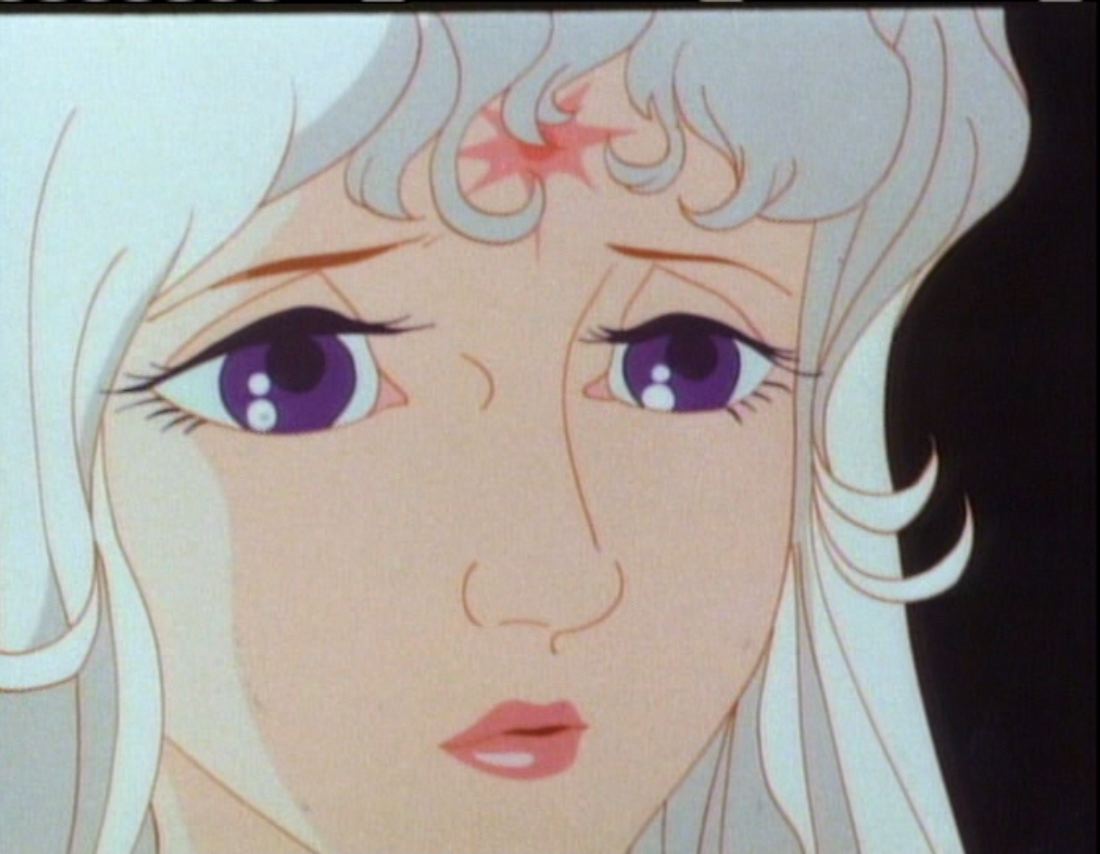
And who are we when we have a big angry forehead zit?  That's right: the Lady Amalthea.

The Last Unicorn is, among other things, a film about how spending time in a woman's body makes you weak and confused and death-prone, but highly lovable.  Unlike the approximately infinite number of other narratives where a strong, independent virgin falls in love and suddenly gets weak ankles (e.g. Rocky, Susan from the Narnia books), Amalthea gets to keep her own body and strength and sense of self, but loses her love.  While I would of course prefer a film where you can have sex without destroying your personality, this one has Christopher Lee, and is therefore recommended.

This hasn't been a good day for Lir.

30 June 2010

I AM POD, THE GREAT AND TERRIBLE

Being, I guess, somewhat dumb, I'm a big watcher of BBC3, though not if there's anything on BBC4.  So it was that, around 2 AM, I would come across Snog Marry Avoid, a makeover show whose title is loosely based on the playground/road trip exercise Fuck Marry Kill.  The premise of the show, as introduced by former Atomic Kitten and increasingly tan person Jenny Frost, is that British women are over-fond of makeup and under-fond of clothing, and with the help of a sassy computer -- bear with me here -- she will reintroduce them to their "natural beauty."  The phrase "natural beauty" is constantly repeated on the show, but poorly defined.  Removing a quarter-inch thick layer of tarry foundation is arguably moving towards natural, but putting a thinner layer on afterward is contradictory; "natural" seems to be synonymous with "brunette" regardless of the color of hair growing from someone's head; and many of these (mostly very young) women come to the show already in a state of unusual naturalness with regards to dress. 

The course of each makeover runs just so: A test subject / victim / contestant / FUTURE TV STAR is introduced with a 360° turn-around of her body in the clothes and makeup she selected to go on the show, angled from about knee-high.  I don't think I've seen a subject not wearing nosebleed-inducing platform stilettos.  There follows a montage showing her ludicrous fashion sense, intercut with shots of her drinking and dancing at clubs and the hours-long process of applying fake tan, false eyelashes, and hair extensions.  Hours-long processes not stressed as contemptible include hair removal, skincare, salon visits, and plastic surgery--at least half of the subjects have breast implants.  I would applaud the show for its lack of commitment to "natural beauty" when that would mean re-cutting up young women to prise out their silicone, if shows like The Swan and Extreme Makeover hadn't made the decision about whether to slice up women seem more like a matter of production costs than morality. 

After the introduction, the subject meets Jenny Frost, who displays her blinding teeth in an attempt to appear friendly.  Frost makes some neutral-to-positive comments about the subject's appearance, before asking if she is "ready to meet POD."  The subject assents, and the scene cuts to her walking into a darkened room.  With a click, a brilliant light floods the stage, lighting the entire background Frost-tooth white.  The subject looks disoriented as her pupils contract, and a sarcastically posh female voice addresses her.  "I AM POD.  WHO ARE YOU?"  The only reason to watch the show is the conceit that this voice comes from a 70s-sized sentient supercomputer whose primary directive is the promotion of "natural beauty" and whose secondary purpose is to self-righteously slag off these subjects without the distraction of possessing her / its own critiqueable body or style.  Gok Wan, take note!  Deny your humanity and embrace metal gender

There's two real flavors of subject on the show: women who have bought into every media-disseminated notion of what makes a woman sexually attractive to men to an outlandish degree (my temptation is to, for the sake of brevity, refer to members of this category as "whores", but this seems like a poor idea for several reasons, the most pertinent being that it strikes me as dismissive of the stylistic choices of actual sex workers); and people who I don't think will be particularly offended if I call them freaks.  Both styles of subject play their role on the show like an audition tape, either flirting and pouting at the computer or acting contemptuously too-cool for its machinations to work on them (respectively, obv.). 

POD is openly hostile and confrontational to subjects about their style of dress and makeup, using an incredulous, personally-affronted tone to berate them about their "fakery".  The show gets away with a great deal here due to its non-human host, including directly asking women if their breasts are "real" (a digression here about this question and its expected response probably deserves to be expanded into its own entry), calling them dirty, stupid, and low-class, and generally treating as stomach-churning the idea that they are making an overt public display of their sexual availability.  And that's before the hard-sell tactics start. 

Everyone is put on the back foot when a computer starts yelling at them, but the freaks tend to be slightly better versed in defending their stylistic choices than the cartoon sexpots.  I always watch in the hope that someone will offer a critique of the idea of "natural beauty", and some do, but I find them all to be pretty inarticulate about it, and to deliver their responses with the arrogance of a snotty teenager who believes she is the first one to have figured out that it's all phony, maaan.  Mostly it comes off as dull people who don't have writers spluttering vainly to come up with a way to own an opponent who has no momma.  Nonetheless, most are deeply protective of their styles. 

The theme of adding a garnish of scientific gravitas to the proceedings continues here with a survey of an undisclosed number of "members of the public"-- a public which appears to consist entirely of moderately attractive men ages 20-35, often the same six or seven men whom I expect are interns on the show -- about whether, seeing a picture of "this girl", they would choose to Snog, Marry, or Avoid her.  Typically there is also a secondary survey asking whether they think she looks like a) a sophisticated lady b) a punny joke answer or c) a filthy whore.  The subject is asked to pick what she thinks the men selected in each case, by pressing a touchscreen button which is also the inside of your television screen.  She views a selection of these men opining about her looks to a camera; they refer to her in the third person and are apparently not privy to her responses.  We the viewer, however, are privy to every emotion that flickers across her face during this time, as the show does not cut away but instead displays the men speaking in a picture-in-picture box. 

The percentages of "avoid" and "filthy whore" responses are obviously higher than the subject would like (that is the premise of the show), and it is at this low point in her estimation of herself that POD asks if she is ready to experience a jocularly and typically also insultingly named "make-under" (e.g. "spunky junkie to middle-class lass").  The subject assents and with a small fanfare is instantly transformed by means of a photocopier-style horizontal bar scanning down her body, replacing the old clothes, hair, and makeup with the new.  I don't have much to say about the content of the makeovers except that they tend to feature minidresses worn with black tights, and that all of the subjects are still wearing stripper platforms with stiletto heels, though occasionally not the ones they hobbled in on.  Another 360° turn-around, and then POD asks the subject if she is pleased.  Subjects express surprise and admiration in a manner that, if I were POD, I would instantly dismiss as utter fakery.  The eponymous survey is re-administered, men say they like the looks of this one, and "avoid" responses decrease to zero.

All the subjects possess a familiar air of arrogant desperation: the attitude of those whose foremost ambition is to be on television, and who to that end have worked and strained and struggled every day of their lives to cultivate a talent for applying to be on reality television shows.  In a highly valid survey I conducted with actual members of the public, 100% of them find viewing youths who cop this attitude to bias them towards thinking that these obvious fame-hounds deserve every bit of the humiliation they volunteer for, as well as making me, I mean them, more likely to cut the show slack for treating its contestants with cruelty.  In the interest of creating sympathy for other human beings even when they are televised, I suggest the overzealous medicalization of an ambition for fame, and the treatment of this dubious pathology with the oversubscribed addiction model. 

The subject bids POD goodbye and turns off the light before walking out and reappearing on the street, where they are met by friends, a partner, or their mother, who usually express a more sincere degree of shock and delight at the new look.  Partners, for probably obvious reasons, tend to be the least expressive of any pleasure they may experience, noting that the subject "looks good whatever you wear", but also averring that they hope she will now spend less time on her makeup.  Often a follow-up interview is conduced by Jenny Frost one month later, where she comes upon the subject during the day in a coffee shop and draws conclusions about whether the televised makeover has made a long-term difference to her clubwear.  There is a high relapse rate, probably because unlike some makeover shows, this one does not take the step of destroying the remainder of the subject's wardrobe. 

The show can knock out three of these sequences in 30 minutes, usually pairing two sexpots with one freak.  It's also puffed up with some interstitial segments in which Jenny Frost tests out DIY beauty aids.  In one frankly gobsmacking scene, Frost uses some old pressed-powder bronzer and lotion to concoct a fake tan solution, then puts her finger to her lips and says "Shh!  Don't tell POD!"  I suppose the show's overall message is something along the lines of "don't overdo it, just be genuine", but that is hard to take from a programme with a magic computer for a host. 

Snog Marry Avoid is one of that new breed of cultural products that are crafted to work on numerous levels: as serious advice for women whose beautification routines have become overwhelming; as a freakshow; as a cynical and frankly sinister co-opting of feminist messages to love the body you have; as dystopic post-industrial sci-fi; and as a parade of slim, barely dressed young women in high heels who get justly punished before they are rewarded for wanting to be good girls.  It's sickly fascinating to me for all these reasons, but after watching a dozen or so youngsters be highly defensive of their off-the-rack streetwalker costumes, I think there's an appeal of this fashion that the steamroller approach to making them "natural beauties" ignores entirely. 

There's a lot of reasons for a young person to feel frightened, anxious, and conflicted about their sexuality today, and slipping into a pre-made persona with preset responses from the alternate sex can provide some feelings of security, of being protected by your mask.  More than that, though, if you make yourself into a panto character, and someone slags you off, it becomes easier to dissociate your private, personal self from their put-downs.  It's not you they're insulting; they don't even know you.  Honestly, how could they?

27 June 2010

What the hell is the point of this

Look, just tell me--are most other women straight, or not?
where does this even figure in to their sexuality I don't know

21 June 2010

alone, dancing


What I find most interesting about porn parodies right now is that the ratio of male characters to female characters in mainstream movies tends to be reversed in porn, necessitating gender swaps and the addition of, in this case, cheerleaders. Sadly, I do not find anything else about them interesting.

20 June 2010

Dual Pickup

While researching unpleasant bands for a minor joke in yesterday's entry, I was struck by the neat complementarity of Ke$ha's unconscionable "Blah Blah Blah" and 3OH!3's despicable "Don't Trust Me".  Taken together, the songs can be seen to circumscribe both sides of a near-anonymous heterosexual relationship characterized by mutual disrespect and loathing.

"Don't Trust Me" (which I consistently mistype as "Don't Trust Men"; oh feminism!) takes the form of an account of the damage on the meat popsicle the narrator is about to intubate, imbued with equal parts nausea and pity. "Blah Blah Blah" consists of a set of instructions addressed to the listener/fuckee.  The central exhortation of each song, the demand each character makes of their partner, is to shut up.

For 3OH!3's narrator, listening to the bruised head-case he is focused on spit-roasting would bring to the surface distressing thoughts that circulate beneath the surface of this song--of whether taking advantage of a fucked-up girl after taking pains to dehumanize her makes him an untrustworthy, terrible person.  Ke$ha's narrator seems, well, simpler: she doesn't want to hear from her interlocutor because she is aware any respect he displays for her is feigned, part of a ploy to trick her into doing what she's intent on doing anyway [him]. 

Because these atrocious songs and the horrible sentiments they express are quite popular, my natural next move should be to bemoan the breakdown of social mores they represent, and perhaps to long for a simpler time before the invention of casual sex or young people.  But this would ignore context, both social and musical.  I'm going to just assert that relations between the sexes are better than they were in the past and leave it there; if necessary I'll defend it in some forum that isn't a blog post about disposable alterna-pop. Musically, these songs exist in a rather long tradition of opposition to love songs expressing admiration--think of "I Just Want To Make Love To You" in 1954 or "You're All I've Got Tonight" in 1978.  Moreover, they aren't popular because of how acceptable it currently is to treat a sexual partner like they were Clippy the Microsoft Office Paperclip, but rather because in an atmosphere of increased respect and communication, being an asshole becomes subversive. 

Personally, I find it heartening that neither of these acts is allowed to go on tv alone anymore: each has to feat. other artists in their videos to lend credibility to the notion that another person could stand to be around them for three minutes.

19 June 2010

not broken, just a baby

I finally got around to watching the video for Alejandro, Lady GaGa's  recent single (heretoafter referred to as Lady Gaga; I'm not made of capitals), after hearing a number of unenthusiastic reviews ("boring"; "totally derivative of Madonna").  I'm generally pro-Gaga, in the same way as I have been generally pro-Madonna: without being a big fan of her music. 

I'm rooting for Lady Gaga to produce challenging public portrayals of her sexuality, even as sinister Music Biz forces work to make these portrayals more consumable.  So in this regard Alejandro is something of a mixed bag.  While you won't see Ke$ha putting out a video in which she ties 3OH!3 to a bed and fucks their asses (if you read this over a year later, Ke$ha was a pop star who needed help finding men's genitals), there's a great deal of sexual violence in this video and almost all of it is visited upon Gaga's fragile-looking person. 

It's certainly tempting to just count up shots of Gaga being choked or bounced around by the musclemen in this video, compare it to the number of shots of her giving it to them in the ass, and render a score -- Music Videos 18 : Feminism 10 -- but this is terrible film crit practice.  Contextually, many interesting things are going on.  To bring out one example, the majority of the shots of what is delicately termed "rough sex" in porn reviews (rough on whom, exactly?) occur during a scene marked out as a wistful flashback of Gaga's late lamented love affair. 

Even if I really believed that the imagery of rape (not to mention bondage, crossdressing, blasphemy--I'm not scrutinizing these things because they just can't beat rape) that runs through this video was being allowed to pass uncritically as decontextualized aesthetic, it would be trite to attempt to insult director/photographer Steven Klein with something so bereft of the power to wound as accusations of misogyny.  No, I will attempt to insult him with accusations of unoriginality.  Sex and violence are done to death as avant-garde postures.  The power of an image to shock can only decrease as it is disseminated and consumed, and literally all of the images in this video are already available in Klein's back-catalog of photographs.

I'm also interested in being, as far as I can google, the first person to connect the video for Alejandro to the 1989 rape and torture of American nun Dianna Ortiz at the hands of the Guatemalan state military.  My evidence for this claim is slight (and I take Gaga at her word that the song itself is nothing more than a tribute to her love of gay men), but Klein has a history of referencing (and sexing up) culturally important rapes.  First, most obviously, the video depicts the gang rape of a nun by Hispanic soldiers.  The weird bowl-cut bobs worn by all the players (bar the commandant or generalissmo or whatever) resemble Ortiz' hairstyle, and the references to cigarettes in the chorus and facial burning in the final shots might be intended to call to mind the soldiers' burning Ortiz with hundreds of cigarettes.

Lastly, when an American CIA operative working with the Guatemalan military (allegedly!) while they were disappearing, raping, and murdering tens of thousands of political opponents--when this alleged operative found Ortiz, before he berated the soldiers for disappearing an American for whom there would be international outcry, before he took Ortiz from the prison where she was held and drove her to Guatemala City in his jeep, before he tried to make her promise to tell no one and to forgive her torturers because it had all been a case of mistaken identity, before she bolted from the car at a stoplight and made it to the American embassy--it was when Ortiz first heard the soldiers greeting a man with an American accent that she heard them call him by name-- "Hey, Alejandro, come and have some fun!"

14 June 2010

Oh good, another blog

Reading lipstickeater and threadbared on consumerism and femininity (recently synonymous) has got me thinking about the development of my own gender expression.

As a child I was never able to put conformity before comfort--when my long rusty hair got painfully tangled at the base of my skull, I cut it off.* Dresses were too scratchy, and besides, my feminist, atheist folks didn't want to burden me with unnecessary gender coding. It was purple or teal slacks and Calvin-style striped shirts all the way.

Then before I was really prepared for it, puberty arrived and my comfort eating began to pack on the pounds. My jeans size went up--8, 10, 12 for a long time, then relaxed fit 12, finally 14--and I bought a ton of men's XL t-shirts with superhero logos.

Through some cultural osmosis or other, I came to the conclusion that girls who cared about the way they dressed and wore their hair were stupid, and since my greatest fear was of looking stupid, I'd stick completely to jeans, jean shorts, and a single, floor-length denim skirt. I'd play with lipstick and blush when no one could see, but without access to women's magazines (soooo stupid) I had no idea how to proceed. So.

Around about the end of middle school, I began also wanting my clothes to express a burgeoning queer identity, albeit not one my parents would be able to decipher. Overlarge Doc Martens with rainbow laces--who could possibly ferret out my genius code? I would ask for my hair as short as the Great Clips drone would willingly cut it, but I could never buck up the nerve to ask outright for the stranger touching my head to give me a man's haircut. Even though that would have been cheaper.

It became important that my clothing was labeled for men, which felt so appropriately transgressive to buy and wear. This would have been the late 90s, post Spiceworld, so I also owned a couple baby tees and spaghetti straps--that was my cover, you see. I dressed for comfort, and to express my contempt for the idea of dressing for anything else. I wanted out of my body.

Second year of high school I started getting really into dyeing my hair. Since it had dulled from new-penny to old-penny during the hated puberty, I had been lobbying my mother to help me go as red as drugstore brands would allow. She would instead steer me to some extremely subtle auburns, probably out of lessons learned from her own youthful hair experiments. These hair colors did fuck-all.

It wasn't until I began colluding with my pixieish friend Aviv to watch anime and become bisexuals that I broke out the 30-vol bleach and did what I assured my folks would be only a tiny blue stripe in my bangs. The way it made me feel was addictive. I wanted to look at myself and I wanted other people to look at me and be shocked and impressed. This is how punks must have felt back when they actually existed.

From an allusional Miki cosplay to a full green head for school photos, I tried on every color, eventually settling down to a good-sized chunk of the spectrum between orange and purple. I tried to avoid stepping on the toes of any of my group of friends who suddenly all had the same close crop and orange or pink hair, but Manic Panic makes a limited range, after all.

Coloring my hair was a huge relief as a largely degendered outlet for my desire to decorate my person. Makeup would have been a minefield--there were too many girls wearing it well, who would know when I wore it poorly. Becoming a goth was always tempting, but too expensive and too likely to draw unwanted parental attention. Though it dyed my collars, pillows, and walls, my hair situated me within my female peer group while letting me stay androgynous.

I kept it up for a bit early in college, but dyeing in a room you clean yourself quickly became a drag. As far as I can intuit, this is the college experience in fashion: the elaborate looks you've created to code yourself to your high school chums erode rapidly, followed by all decorum and grooming. You'd just roll out of bed and put on whatever was closest to hand and easiest to pull over your head. That's right--those collegiate fuckers were completely biting my high-school look. This could not stand, because if everyone looked like me, no one would comprehend instantly how blindingly superior I was.

I started drawing up plans for my all-new style. It would be based on the tuxedo, all crisp white blouses with black jackets, skirts, and trousers. Basically, I decided that the ideal look would be "waiter". To that end, I started to haunt thrift stores. I started to pay attention.

The other thing that happened was, I started to lose weight. Mainly this was from living on microwave popcorn rather than food, but seeing that it was possible for me to lose weight lit a fire in me. I dieted and exercised religiously, skirting the edge of an eating disorder. I was constantly hungry, angry, paranoid and antisocial, I had a mini nervous breakdown and quit college for a while, and I dropped from 180 lbs to 120. Overall, a classic female success story!

My wardrobe, by contrast, expanded rapidly. A frenemy had opined that I was "unfeminine" and therefore unattractive, and because by this time I was desperate to attract anyone's company, I took it as a challenge. Dresses, skirts, and frilly tops began to attract my coin. I had decided that I would still be queer, but now I would be a femme queer. My logic was, and still occasionally is, that the feminine is degraded and disregarded in a misogynist society, and that I would work on redeeming feminine dress and practices (while reaping the benefits of being viewed as socially compliant).

I wasn't alone, either. All kinds of young women were turning from the androgynous styles of the 90s to "new Romantic" or "retro" or any of a dozen other ways to say a highly femininzed, desperately sexualized fashion turn towards a safe imaginary past. My passage into the feminine had been well-greased by strong cultural forces with an interest in getting me to fit in.

Moving from a socially unacceptable body and dress style to a socially acceptable one did get me positive attention. From guys. In fact, a number (3) of guys stepped up to tell me that they had even liked my socially unacceptable body, but had been wary of asking out an obvious lesbian. The threat to my queer identity boys posed was outweighed by a genuine attraction to men and an o'erpowering desire to fuck someone who was not also a virgin (sorry erstwhile roommate!). I dated a bit, then fell in love with the man of my dreams and, well, put the queer identity on a shelf so as not to be called a bisexual poseur.

Still and all, I hadn't counted on the fact that a decade of studiously ignoring fashion and, well, grooming would leave me without the necessary skills and aesthetic sense to dress myself in the mornings. I wore a bunch of bad shit. Well, they don't call it trial and success, eh?

Despite looking at girls for years, I had no idea how to suddenly become one. The girls of my acquaintance, too, wore jeans and t-shirts, but with a hundred subtle touches that resulted in feminine presentation. But, look, fuck subtlety. If I was going to learn anything about girl drag, I was going to have to try too hard. Instead of looking at the women around me, I looked to caricatures: the sex-nuts Victorians and the 1950s pin-up housewife. An hourglass exaggerated by a full skirt and a cinched waist: that was my jumping-off point into femninity. It felt like a masquerade, a costume you wear until it inhabits you, similar to the enchanted (and sexy!) costumes in Buffy the Vampire Slayer's second-season Halloween episode, "Halloween."

In any case, it's been a few years since then and I'm generally happy with my dress sense and makeup skills, though I still have a ways to go with hair. I'm ambivalent about what my newfound love of adornment means for me. When I began to pour my creative energy (what little energy I possess) into looking pretty, I lost much of my drive in art and writing, which I always thought would redeem me being bad-looking. My ambition to do what I consider valuable has plateaued while I work on this new outlet, which is ephemeral, dubiously rewarding, and arguably unfeminist. I read any kind of cultural studies I can lay hands on to try and understand my fascination with and compulsion to create myself anew on the site of my body. So this is my attempt to make a style blog which is against the idea of style blogs, to become an anti-fashion guru, to create criticism, to redereconstruct. My secondary goal is to not be needlessly cruel to anyone while doing this, so if you see me being, say, racist, please let me know.


*Random bolding strategies in this post owe everything to Slog.