Showing posts with label video games. Show all posts

27 October 2013

PLEASE GENDER-SWAP EVERYTHING, BECAUSE YOU DON'T KNOW HOW TERRIBLE YOU ARE YET

THE LAST OF US

The world has been overrun with zombies, as usual, and the only people who survive are rugged individuals and bands of armed mercenaries.  You play as an ordinary tween girl, El, tasked by a boy you love and trust with protecting a headstrong middle-aged man, Joely, who may hold within his delicate body the key to human salvation.  For the first half of the game, you must use your skills to keep him safe, though eventually you trust him enough to give him his own pistol and he assists you during fights.  You grow to bond with your grizzled middle-aged companion through a series of incidents, while stubbornly denying that he is nothing more to you than a surrogate for your own father.  When you are gravely injured, Joely feeds you and brings you medicine, but while he is on his own he is captured and held by the tween leader of a cannibal cult, forcing you to torture and kill the cult members you capture before mounting a raid on their compound to rescue him.  

In an innovative twist, you are briefly allowed to play as Joely (though admittedly only while El is incapacitated by injury).  The writers have gone out of their way to present the men in this game as having their own agency and goals, a laudable change from the passive wriggle-and-squeal tropes of men in video games.  Also refreshingly, no one suggests that the cannibals will abuse Joely sexually (perhaps because of his age), only that they are likely to eat him.  The violence, however, is still quite shocking: especially when you play sidekick, the animations have you stabbing girls many times in the eyes, neck, and groin to disable them.  The context cues of the game ensure that whenever El kills a girl, you know you are killing a human being with personal relationships to her sisters-in-arms, and one of the last human survivors of the apocalypse--all the more distressing because the game frequently requires you to kill all the girls in an area before you can progress.  

The visuals, writing and music in the game are all top-notch, but it suffers from being mired in a survivalist fantasy that has always been about honoring and privileging feminine skills at the expense of masculine ones.  The world of The Last of Us is designed to make technological consumerism, lawn-mowing, and high-shelf-reaching look like ridiculous, obsolete skills; mending, cooking, conflict resolution and child-rearing are the valued skillsets of the post-apocalyptic age.  It gives me pause that so many of our modern fantasies are about this type of world.  It seems to presage a generation of women dreaming about a world where they can be respected for their base animal qualities, without having to worry about male concerns or social pressures.  I shudder to think about the position of men in such a world.  

03 February 2011

Weighing in on Dickwolves

My background: I've been reading Penny Arcade since 1999, I've been reading feminist blogs since the invention of blogs, I am intimately familiar with the way internet arguments escalate, and I have a sense of humor.  My take, which you should understand is the correct take from what a fucking expert I am on all these topics, is that PA made a perfectly appropriate rape joke which no one ought to have objected to, and then a funny comic mocking the concept of rape culture, and then a series of increasingly swinish moves, followed by an absolutely stellar apologyPretty much everyone else has behaved execrably. 

Out-of-context criticism is absolutely endemic to feminist blogging, and I think it's because expressing solidarity for rape victims outweighs pretty much any other concern including accuracy and fairness.  This is a value feminists have: if you asked most feminist bloggers what motivates them to blog, "because somewhere, a woman is being forced to have sex against her will" is going to be high on the list.

But qualities of the crime of rape are variable and resist conforming into an overarching social narrative of cause and effect, whether this narrative is "rape culture causes rape" or "women's rape claims are strategically-motivated".  Proponents of each narrative have their own shibboleths and very little patience for views or data that fit their narratives badly.  And why would they display patience?  Either there's a world of women whose lives have been destroyed by rape, or a world of men whose lives have been destroyed by false accusation--in either case, the appropriate response to this terrifying world of arbitrary injustice is outrage and activism. 

My personal, meaningless opinion is that there are probably numerically more rape victims than falsely-accused rapists in the Western world, but it would certainly be easy to receive the opposite impression.  False rape accusations have inherently longer news cycles, for example, and tend to leave believe-the-victim feminists looking credulous.  Also, my high-school sex-ed teacher has by now taught generations of young men that a woman whose lips have touched even a single drop of liquor will be fully supported by society and the legal establishment in railroading any young men who foolishly have sex with her to federal pound-me-in-the-ass prison.

I suppose reviewing rape conviction rates from reality would have conveyed the impression that you could do quite a lot of rapes without fear of prosecution, and so I see why she presented this nugget of men's mythology instead--still, it joins the pinpricked-condom and half in undergirding a worldview where relationships with women are a threat.  And the complementary worldview in which men are a kind of deadly animal who mainly abuse, rape, stalk, and discriminate against women is, of course, prevalent in its own circles. 

Now, on the internet, these ideologies are taken up by people whose knowledge of the nuances of their apologia vastly outweigh their experience with, e.g. the mechanics of sex, and so everything is really angry and stupid and broad.  In the case of feminist blogging, I've seen this translate into a practice of defending the notional traumatized rape victim at all costs (for example by tagging up every fucking post with "trigger warning"), even against actual rape survivors who, after all, are women who continue to live and crack wise and have idiosyncratic opinions even if the rhetoric we use tends to present them as broken or no longer fully human ("lives destroyed" earlier in this post, for instance).  For the video gamer, it is probably fairly difficult to transition suddenly to the feminist version of a term ("nonconsensual sex") which is in ubiquitous use in his subculture as a synonym for "defeat soundly", and in general use as something more like "sex obtained at knife-point, by a psychotic stranger, from a jogger".  The gulf between definitions, not to mention the existence of complete assholes on various sides, makes some kind of conciliation between ideologies a seeming impossibility. 

I'm not sure that I can bring all this together to some kind of conclusion.  I'm not sure anyone can.  I'd like to see everyone treating the person glimpsed through the screen like they were sitting beside them, but I don't exactly follow this precept in my own online conversation, and I am a bit of a dick IRL besides.  And I'd like to see fewer rapes and, I guess, fewer false accusations of rape.  I suppose I can do worse than conclude by quoting Tycho: "Go, and rape no more."

02 September 2010

Mannequins with Kill Appeal

"It only got a 30?!  You're shitting me."
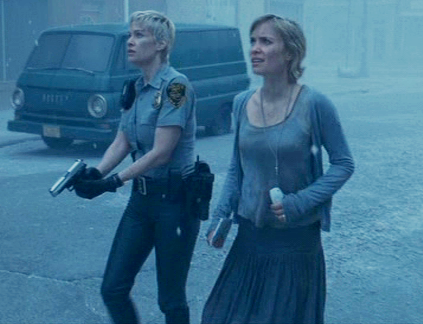
There's nothing for it: I've got to stump for the redemption of the film version of Silent Hill.  This is a movie, and I can't stress enough how unusual this is for me, where I had put it on in the background while I gazed into the internet but then found myself more and more drawn to the film and actually put the internet to one side altogether so I could watch it closely.  After it finished, I returned online again to look up the reviews, which I vaguely recalled being bad.  I was wrong: the reviews of this movie eviscerated it.  They are literally worse than Gothika.

I don't know if it had been a disappointing summer and all the critics were hot and angry or what, but there are far more deserving targets that received an indulgent pass while Silent Hill was getting its neck stomped.  I daresay there was an aspect of revenge in it: TriStar refused advance screenings, to mitigate an expected poor response, and critics clearly jumped at the chance to punish this behavior.  Horror is not the genre to work in if you're hung up on critical acclaim in any case, but when 28 Weeks Later, Shadow of the Vampire, and THX 1138 get scores in the 70s on Metacritic while Ravenous, Final Destination, and Saw have scores in the 40s, some metric other than quality of filmmaking is clearly being drawn on to evaluate them. 

I must say, first, that I have never played through a Silent Hill game, because they are scary and I get scared.  I can't, therefore, relate to some people's experience of the film as a betrayal of the franchise, comparing it against the film that should be there.  I have the luxury of only being able to evaluate what is there.

I NEED AN ADULT
I don't mean to argue that Silent Hill is a very good film, heavens no.  I'm quite comfortable losing that argument.  It just has much to recommend it and is, though this is faint praise indeed, a standout among video game adaptations.  The critical perspective I draw on which rewards me richly when I watch Silent Hill is a feminist critique, something that's still fairly thin on the ground in movie review circles.  It's very much a women's picture, if such a thing still exists: all of the characters save those inserted at the behest of execs are women; the horror is that classically feminist style, body horror; it doesn't use women's suffering primarily to titillate a presumed male gazer, as Gothika does; and, as in Aliens, it's not so much big dumb guns as motherhood that saves the day.  As far as I'm aware, no marketing to a specifically female demo was attempted: the trailers just about reproduce Sean Bean's role in full, the way the marketing for Scream was cut to suggest that Drew Barrymore survived the credits. 

The storyline is a regular ghost one, revenge/justice for a female victim of patriarchal violence and social ostracism, here with heavyhanded religious overtones that do little besides absolve the viewer of responsibility for the mistreatment of women unless they're a member of a Christosatanic cult.  The town and its horrors are explicitly manifestations of the psyche of this ur-victim.  Frankly, I'd rather have it that way than how supernatural elements are manifest in most horror films, where characters devised specifically to treat a protagonist's experiences of non-materialistic phenomena with skepticism are then punished for their disbelief with grisly death.  Here the grisly death is distributed much more impartially, which is always refreshing. 

The main thing going for Silent Hill outside of its feminism is its atmosphere.  All the exteriors are dampened in a gray-white mist where black ash falls from the sky like snow, and all the interiors have the perfect quality of urbex in a dying steeltown.  The town itself is based on the story of Centralia, Pennsylvania, but I can't help but think Roger Avery missed a trick (one of, you know, many) not writing it as a more explicit portal to hell.  The monsters have been designed from the principle of the uncanny valley, and I can't think of an instance where it's been used more pitch-perfectly, except maybe Gore Verbinksi's version of The Ring, another female-focused atmospheric horror. 

Generally the film is about mothers and daughters, which may explain the low level of sexualization experienced by the cherubic Radha Mitchell as main/final girl Rose.  Her companion for most of the film, Laurie Holden's Officer Cybil, has a cop-appropriate blatant lesbian image.  She's sexualized, but as a sleek muscular object along the lines of Robert Patrick halfway through unmelting himself in T2.  The rest of the film's sex is tied up in Pyramid Head, here a straightforward avatar of rape, and the mannequinesque nurses, whose forest of bared cleavage Rose has to cautiously pick her way through lest she be torn to ribbons.

"I would have liked more time with the cleavage nurses
and less with the religious fanatics."
Now, I think Tycho's a hundred percent correct when he says that the style of the film evokes the style of video games.  I've seen just about all the video game movies, and I've played a fair amount of survival horror, and I've seen a fuckton of cutscenes.  And the quality of cutscenes is this: they contain a lot of bad, clunky exposition, and they contain a lot of visual spectacle.  Their function is to provide a break in the action which briefly suspends the player's control in the interest of advancing the plot.  Silent Hill retains the cutsceneness closely enough that I kept feeling like I ought to be pressing X.

I don't put much stock in the idea of faithfulness as a measure of the quality of an adaptation--who wants to hear a cover of a song identical to the original, anyway?--but I have love for films that have love for their source.  Christopher Gans spent years trying to obtain the rights to Silent Hill, going so far as to create his own fan-film scored with the Silent Hill soundtrack and send it to the game's creators.  Aided by this purity of feeling, he's produced something that expresses the spirit of, if not the games themselves (for how can I judge that), the medium and the genre they spring from.  The whole idea of survival horror is that you are resource-poor and nearly powerless in a landscape designed to do you harm, and from themes to sets to characters, the movie carries this idea through wonderfully. 

I can't say I don't feel a little hurt that Silent Hill was panned so especially badly, because the symbolic language it used was so close to my own experience of feminine terror, and so keenly expressed.  When I read through mainstream reviews, I can see that none of that has come through for most reviewers, and as usual with an adaptation (especially from a devalued medium), a number of them have felt free to just make shit up to pretend familiarity with the source, like when Roger Ebert wrote that the brilliant colors of From Hell closely evoked the graphic novel.*  Fans of the game are also very angry at the ways in which it differed from the movie that happened in their minds, but that kind of bitching has been easier to write off since Watchmen.  When I look at amateur reviews, such as this one from the Bechdel Test site, though, I get the feeling that I'm not the only one who sees the value in it. 

"30, though!  What the fuck."
*Maybe I am conflating him with a different critic, but I swear that someone said this, and Ebert is a critic I have no real issue with slandering in a post that touches on gaming. 

25 August 2010

As my friend whom I’ll call Sam says, “I’ve dated women with everything from an A-cup to a D"

Every day or so I spend on the internet, I come across one of the five to six hundred iterations of this article, on what women can stop doing to attract men.  It's always written from the perspective of someone whose sole claim to authority on the subject is that they are a guy, which mystifies me: can there really be women who have no male friends or acquaintances that would bloviate rapturously on what they believe would most please a man?  In any case, all these articles boil down to a variation on the sentiment, "It's important that you be well-groomed, but I want you to stop spending time on grooming so that we can have more time to do things I like, such as touching a boob."  There is some kind of disconnect in these men's brains between cause (grooming) and effect (groomed) that probably also makes them Libertarians. 

Anyway, if men would like to take my big-ass gametes as qualification to tell them what all women think, and if they would like to stop doing something which completely fails to impress me, they could stop pretending to give a shit about sports.  I know, some women may claim to enjoy sports or like the company of men who do, but because they disagree with me, they're unrepresentative.  I suspicion that all the women who say they like sports don't really but are just pretending in order to attract men.  I am myself constitutionally incapable of enjoying sports and generally distrust the motives of anyone who does, but that shouldn't affect how totally right I am about this. 

Men, I think, only profess to like sports because if they don't other men will relentlessly hound them with accusations of homosexuality.  In men, I judge liking a thing which is inherently unlikeable to impress men to be understandable, and pitiable in a sympathetic way.  In women, I judge liking that unlikeable thing to impress men to be a contemptible betrayal of one's authentic self.  This double standard is my stake in the ground, now let's pretend it's the Daily Show and go to the part of the tape where I contradict myself utterly. 

So, video games.  I am strongly attracted to video games because for the past twenty years they've had the exciting, disreputable sheen of The Next New Media, with regularly-scheduled moral panics providing a rebellious charge to liking them.  And, if I'm honest, because the boys I always liked always like gaming--the weird boys, the boys with the D&D books and the graph paper and anime porn.  Though they could stop with the anime porn, frankly.

Now, I am fucking shit at video games.  I have terrible reaction time and I am emotionally devastated if I can't beat a level on the third or fourth try.  I can't play against people because I get upset if they win too much and worried about what they think of me if I win too much, and if I have any difficulty at all I'll be fighting the urge to wander off and never finish. 

It's clear to me that games, even more than films or books (but maybe not as much as music), serve as mile markers in the lives of the people who love them, bound up in memories of where and who they were when they played Metal Gear Solid or Bioshock or Chuckie Egg.  Nostalgia is such a powerful force in the industry because gaming is so experiential: when you play something that touches you, you're really stitching it into your life in the strongest way possible without actually parachuting into the jungle and fighting Russians while feeding on tree frogs.  And my favorite thing is to hear people articulating their memories, to know what they love and why it animates them.  But ideally without reference to the infield fly rule.