Showing posts with label rape. Show all posts

21 August 2012

Runcible Rape

So, if you're a person, you're probably aware of the latest spasm of insane nonsense in Republicans' ongoing battle against women who have bodies: Todd Akin's assertion that pregnancies resulting from rape were rare enough to be a non-issue in outlawing abortion, because the wombs of women who were victims of "legitimate rape" had a mechanism by which they would "shut that whole thing down."  This fantasy must be a great comfort for anyone who is genuinely troubled by the idea of a woman suffering through an additional humiliating, expensive, life-threatening ordeal after a traumatic assault, yet who must still demand that such a woman be prevented at all costs from accessing safe abortion services.  Akin was at first roundly decried by all sane people everywhere, then right-wingers demanded that we shut up about how terrifying it is that this idiot is allowed to make laws on health care and science and that we ought to only talk about how bad the economy is.  After that, a number of defenders of the sanctity of life until birth emerged from their Morlock caves, and now we have a media "debate" about "legitimate rape" just as we had a "debate" about going to war in Iraq, torture, global warming, et al, ad nauseum.

I am, by nature, an internet feminist, and so in this case I want to discuss issues of language.  When Akin laid his giant head on the sympathetic lap of Mike Huckabee the day after his moronic remarks, he explained that he had misspoken, and that by "legitimate rape" he had of course meant "forcible rape", rather than something that was worth the little ladies getting all het up over.  This term, "forcible rape", has a long history in the anti-abortion fight, most recently when Paul Ryan and Todd Akin forcibly inserted the phrase into a bill which would have denied any federal funding for impoverished women's abortions unless they were victims of rape.  "Rape" not being rapey enough, the co-sponsors made sure the bill read "forcible rape."

Now, "forcible rape" is a bit of a poser, as a phrase something like "close proximity" or "unexpected surprise" or "personal friend."  It modifies a noun by placing before it an adjective which is a central defining characteristic of that noun.  "Rape" means sex which is forced, coerced, produced through threat or violence.  Now, I'm not against differentiating between different circumstances of rape via categorical adjectives, if it helps break the idea of stranger-rape being the typical case, which arguably phrases like "date rape" or "acquaintance rape" do.  But the very use of the words "forcible" and "rape" in conjunction suggests that people who use it believe that there are other species of rape which are important to distinguish from this type.

Indeed, the one which anti-abortion campaigners suggest as an example of non-forcible rape is statutory rape.  Now, I haven't thought much about statutory rape since I stopped wanting to have sex with teenagers, at around age 19, but I think I have a pretty good handle on the right-wing objection to statutory rapes being included in the category of "rape" for the purposes of judging victims' merit.  The idea is that that slutty teens (abetted by the satan-worshipping lesbians at Planned Parenthood) will be so keen to get free abortions that they will (falsely, it is assumed) accuse venerable older men of consensually raping them, so the state had better at least ask the teens to display some vaginal bruising to back up their accounts.  Again, this is a fantasy of female evil created by anti-abortionists to escape from the knowledge that they are hurting children, rape victims, and women in general with their stance against modern fertility control methods.  Statutory rape is not a perfect legal construct, but it codifies the idea that extreme power imbalances, such as those that exist between children and adults, create a coercive atmosphere in which the child's consent is not legally meaningful when compared to the adult's coercion.

Anyway, all this is to suggest that, when you see the phrase "forcible rape" used as though it were a serious concept, you might well want to substitute "runcible rape," because "runcible" is a delightful nonsense word created by Edward Lear, and "forcible rape" IS A NONSENSE TERM CREATED BY POWERFUL SOCIOPATHS.

26 November 2011

Men Ain't Call Me Shit

My enthusiasm for blogging has been on the wane for some time, but nothing has been quite as boner-killing as the recent outpouring of feminist bloggers' litanies of death and rape threats they have received from readers.  This mirrors a lot of my experiences with the feminist blogosphere, in that it's an awareness-raising campaign about an apparently universal female experience (rape threats when you express a feminist opinion online) that has never happened to me.1

I have two main reactions when my whole sphere suddenly lights up with solidarity over how men are always treating you as primarily sexual objects.  First, there's the reaction of horror at the malice these women experience, which makes me genuinely fearful about blogging and being in public.  Later, as I read more and more and learn how widespread such campaigns of internet terror seem to be, I begin to wonder what on earth is so wrong with me that apparently no one wants to choke me with cocks for my opinions.

It's a real headfuck.  The consciousness-raising, solidarity-promoting campaign to reveal the extent of the abuse other women have suffered in silence makes me feel pressured to either self-censor my own lack of abuse or attempt to compete with other feminists in the victimhood stakes.  While I often feel alone in my (patently dickish) reactions, I know I'm not alone when I feel pressure to conform to feminist narratives of victimization, because shit like this crops up from time to time.  I have a great horror of becoming an editor of my own experiences to match the narrative of a group I ache to belong to. 

I'll try and work on my failures of empathy. In the meantime, I think I can advance an explanation of the origin of rape threats themselves, which many feminists seem to be crying out for.  In brief:
1) Everyone feels massively threatened by the current climate of fear and despair, even male sexists.
2) Powerless male sexists feel that the feminist narrative has totally won out and they are disenfranchised, making attempts at civil disagreement futile.  Feminists, despite feeling themselves embattled and fearful, are perceived to present male empowerment and female disempowerment as universal rather than situational and relative. 
3) Powerless male sexists cast around for ways to silence feminist arguments they feel are so wholly baseless (due to their own experiences as embittered social rejects) that they cannot engage with them intellectually. 
4) Because women have a sex, sexists settle on the notion of attacking their ideological opponents at this point of weakness.  Historical styles of disciplining misbehaving women are employed, which mostly hinge on women's desirability as sexual objects.  Men who advance opinions which are similarly objectionable to reactionaries receive a different style of threat--threats of violence toward themselves or their loved ones, accusations of homosexuality, or threats towards their jobs.  Men perceive the problem of threats as a lamentable characteristic of public life, while women perceive it as a problem of their gender. 
5) Real patriarchs continue to live blissful lives unfettered by consequence while the rabble tear each other to pieces. 

1. "Ah, privilege!" cry the feminist bloggers.  "Your existence has been so privileged that you may even regard our identification of your privilege," they add, "as simply a way of dismissing any experiences which contradict our narratives."

03 February 2011

Weighing in on Dickwolves

My background: I've been reading Penny Arcade since 1999, I've been reading feminist blogs since the invention of blogs, I am intimately familiar with the way internet arguments escalate, and I have a sense of humor.  My take, which you should understand is the correct take from what a fucking expert I am on all these topics, is that PA made a perfectly appropriate rape joke which no one ought to have objected to, and then a funny comic mocking the concept of rape culture, and then a series of increasingly swinish moves, followed by an absolutely stellar apology.  Pretty much everyone else has behaved execrably. 

Out-of-context criticism is absolutely endemic to feminist blogging, and I think it's because expressing solidarity for rape victims outweighs pretty much any other concern including accuracy and fairness.  This is a value feminists have: if you asked most feminist bloggers what motivates them to blog, "because somewhere, a woman is being forced to have sex against her will" is going to be high on the list.

But qualities of the crime of rape are variable and resist conforming into an overarching social narrative of cause and effect, whether this narrative is "rape culture causes rape" or "women's rape claims are strategically-motivated".  Proponents of each narrative have their own shibboleths and very little patience for views or data that fit their narratives badly.  And why would they display patience?  Either there's a world of women whose lives have been destroyed by rape, or a world of men whose lives have been destroyed by false accusation--in either case, the appropriate response to this terrifying world of arbitrary injustice is outrage and activism. 

My personal, meaningless opinion is that there are probably numerically more rape victims than falsely-accused rapists in the Western world, but it would certainly be easy to receive the opposite impression.  False rape accusations have inherently longer news cycles, for example, and tend to leave believe-the-victim feminists looking credulous.  Also, my high-school sex-ed teacher has by now taught generations of young men that a woman whose lips have touched even a single drop of liquor will be fully supported by society and the legal establishment in railroading any young men who foolishly have sex with her to federal pound-me-in-the-ass prison.

I suppose reviewing rape conviction rates from reality would have conveyed the impression that you could do quite a lot of rapes without fear of prosecution, and so I see why she presented this nugget of men's mythology instead--still, it joins the pinpricked-condom and half in undergirding a worldview where relationships with women are a threat.  And the complementary worldview in which men are a kind of deadly animal who mainly abuse, rape, stalk, and discriminate against women is, of course, prevalent in its own circles. 

Now, on the internet, these ideologies are taken up by people whose knowledge of the nuances of their apologia vastly outweigh their experience with, e.g. the mechanics of sex, and so everything is really angry and stupid and broad.  In the case of feminist blogging, I've seen this translate into a practice of defending the notional traumatized rape victim at all costs (for example by tagging up every fucking post with "trigger warning"), even against actual rape survivors who, after all, are women who continue to live and crack wise and have idiosyncratic opinions even if the rhetoric we use tends to present them as broken or no longer fully human ("lives destroyed" earlier in this post, for instance).  For the video gamer, it is probably fairly difficult to transition suddenly to the feminist version of a term ("nonconsensual sex") which is in ubiquitous use in his subculture as a synonym for "defeat soundly", and in general use as something more like "sex obtained at knife-point, by a psychotic stranger, from a jogger".  The gulf between definitions, not to mention the existence of complete assholes on various sides, makes some kind of conciliation between ideologies a seeming impossibility. 

I'm not sure that I can bring all this together to some kind of conclusion.  I'm not sure anyone can.  I'd like to see everyone treating the person glimpsed through the screen like they were sitting beside them, but I don't exactly follow this precept in my own online conversation, and I am a bit of a dick IRL besides.  And I'd like to see fewer rapes and, I guess, fewer false accusations of rape.  I suppose I can do worse than conclude by quoting Tycho: "Go, and rape no more."

02 September 2010

Mannequins with Kill Appeal

"It only got a 30?!  You're shitting me."
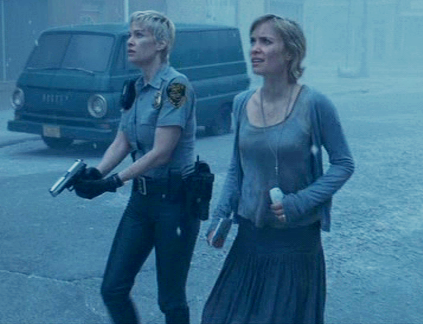
There's nothing for it: I've got to stump for the redemption of the film version of Silent Hill.  This is a movie, and I can't stress enough how unusual this is for me, where I had put it on in the background while I gazed into the internet but then found myself more and more drawn to the film and actually put the internet to one side altogether so I could watch it closely.  After it finished, I returned online again to look up the reviews, which I vaguely recalled being bad.  I was wrong: the reviews of this movie eviscerated it.  They are literally worse than Gothika.

I don't know if it had been a disappointing summer and all the critics were hot and angry or what, but there are far more deserving targets that received an indulgent pass while Silent Hill was getting its neck stomped.  I daresay there was an aspect of revenge in it: TriStar refused advance screenings, to mitigate an expected poor response, and critics clearly jumped at the chance to punish this behavior.  Horror is not the genre to work in if you're hung up on critical acclaim in any case, but when 28 Weeks Later, Shadow of the Vampire, and THX 1138 get scores in the 70s on Metacritic while Ravenous, Final Destination, and Saw have scores in the 40s, some metric other than quality of filmmaking is clearly being drawn on to evaluate them. 

I must say, first, that I have never played through a Silent Hill game, because they are scary and I get scared.  I can't, therefore, relate to some people's experience of the film as a betrayal of the franchise, comparing it against the film that should be there.  I have the luxury of only being able to evaluate what is there.

I NEED AN ADULT
I don't mean to argue that Silent Hill is a very good film, heavens no.  I'm quite comfortable losing that argument.  It just has much to recommend it and is, though this is faint praise indeed, a standout among video game adaptations.  The critical perspective I draw on which rewards me richly when I watch Silent Hill is a feminist critique, something that's still fairly thin on the ground in movie review circles.  It's very much a women's picture, if such a thing still exists: all of the characters save those inserted at the behest of execs are women; the horror is that classically feminist style, body horror; it doesn't use women's suffering primarily to titillate a presumed male gazer, as Gothika does; and, as in Aliens, it's not so much big dumb guns as motherhood that saves the day.  As far as I'm aware, no marketing to a specifically female demo was attempted: the trailers just about reproduce Sean Bean's role in full, the way the marketing for Scream was cut to suggest that Drew Barrymore survived the credits. 

The storyline is a regular ghost one, revenge/justice for a female victim of patriarchal violence and social ostracism, here with heavyhanded religious overtones that do little besides absolve the viewer of responsibility for the mistreatment of women unless they're a member of a Christosatanic cult.  The town and its horrors are explicitly manifestations of the psyche of this ur-victim.  Frankly, I'd rather have it that way than how supernatural elements are manifest in most horror films, where characters devised specifically to treat a protagonist's experiences of non-materialistic phenomena with skepticism are then punished for their disbelief with grisly death.  Here the grisly death is distributed much more impartially, which is always refreshing. 

The main thing going for Silent Hill outside of its feminism is its atmosphere.  All the exteriors are dampened in a gray-white mist where black ash falls from the sky like snow, and all the interiors have the perfect quality of urbex in a dying steeltown.  The town itself is based on the story of Centralia, Pennsylvania, but I can't help but think Roger Avery missed a trick (one of, you know, many) not writing it as a more explicit portal to hell.  The monsters have been designed from the principle of the uncanny valley, and I can't think of an instance where it's been used more pitch-perfectly, except maybe Gore Verbinksi's version of The Ring, another female-focused atmospheric horror. 

Generally the film is about mothers and daughters, which may explain the low level of sexualization experienced by the cherubic Radha Mitchell as main/final girl Rose.  Her companion for most of the film, Laurie Holden's Officer Cybil, has a cop-appropriate blatant lesbian image.  She's sexualized, but as a sleek muscular object along the lines of Robert Patrick halfway through unmelting himself in T2.  The rest of the film's sex is tied up in Pyramid Head, here a straightforward avatar of rape, and the mannequinesque nurses, whose forest of bared cleavage Rose has to cautiously pick her way through lest she be torn to ribbons.

"I would have liked more time with the cleavage nurses
and less with the religious fanatics."
Now, I think Tycho's a hundred percent correct when he says that the style of the film evokes the style of video games.  I've seen just about all the video game movies, and I've played a fair amount of survival horror, and I've seen a fuckton of cutscenes.  And the quality of cutscenes is this: they contain a lot of bad, clunky exposition, and they contain a lot of visual spectacle.  Their function is to provide a break in the action which briefly suspends the player's control in the interest of advancing the plot.  Silent Hill retains the cutsceneness closely enough that I kept feeling like I ought to be pressing X.

I don't put much stock in the idea of faithfulness as a measure of the quality of an adaptation--who wants to hear a cover of a song identical to the original, anyway?--but I have love for films that have love for their source.  Christopher Gans spent years trying to obtain the rights to Silent Hill, going so far as to create his own fan-film scored with the Silent Hill soundtrack and send it to the game's creators.  Aided by this purity of feeling, he's produced something that expresses the spirit of, if not the games themselves (for how can I judge that), the medium and the genre they spring from.  The whole idea of survival horror is that you are resource-poor and nearly powerless in a landscape designed to do you harm, and from themes to sets to characters, the movie carries this idea through wonderfully. 

I can't say I don't feel a little hurt that Silent Hill was panned so especially badly, because the symbolic language it used was so close to my own experience of feminine terror, and so keenly expressed.  When I read through mainstream reviews, I can see that none of that has come through for most reviewers, and as usual with an adaptation (especially from a devalued medium), a number of them have felt free to just make shit up to pretend familiarity with the source, like when Roger Ebert wrote that the brilliant colors of From Hell closely evoked the graphic novel.*  Fans of the game are also very angry at the ways in which it differed from the movie that happened in their minds, but that kind of bitching has been easier to write off since Watchmen.  When I look at amateur reviews, such as this one from the Bechdel Test site, though, I get the feeling that I'm not the only one who sees the value in it. 

"30, though!  What the fuck."
*Maybe I am conflating him with a different critic, but I swear that someone said this, and Ebert is a critic I have no real issue with slandering in a post that touches on gaming. 

16 August 2010

Instructive Failures

 I am something of an academic by nature, and it is to this I attribute my (apparently unusual) high tolerance for didactic cinema.  I'm not saying I could sit through Crash without yelling at the screen or anything, but I stuck with Studio 60 long after the show had dropped all pretense of being anything other than Aaron Sorkin's Chew On That Hour.  Sorkin is that entertainer who pulls a rabbit out of a hat in a novel and entertaining way, and then when the audience clamors "Amazing!  More tricks!" just pulls the same rabbit out of some slightly different hats over and over again until everyone has left.  It's not an uncommon mode for artists, and the first rabbit you see can be really something.

I never watched Sorkin's most beloved creation, The West Wing, but I feel like I understand the kind of catharsis it provided to progressives rendered catatonic by the actions of the Bush administration to have a shadow cabinet play out their Al Gore fantasies.  I'd seen Sports Night and enjoyed as much of it as I understood when it was first on, years before my partner told me he was really getting into Studio 60.   We watched almost all of the doomed first season together.  It's probably telling that I've seen the show up to the big nineleveny cliffhanger in which a main character's life hung in the balance, and have not yet felt a need to see whether she lives or dies.

What finally killed my willingness to indulge Studio 60's oratory, that I might learn something about how American topical sketch comedy shows are formed, was a dawning awareness of a certain tendency it had in common with a lot of modern screenwriting.  It was what instantly put me off Fringe and of course Heroes: a compulsive need to subvert audience expectations that turns pathological.  The fall of Heroes between its first and fourth season is...well, already this post is of extreme length, and I could go on essentially indefinitely about what went wrong there, breaking it down fractally, shot by shot.  But basically what killed Heroes was trying to surprise the fan community by refuting their expectations, especially when they expected a sensical, meaningful plot. 

For Fringe, the expectations it was subverting were those created by The X-Files, which in 1993 was itself subverting an audience expectation by creating a skeptical and science-minded female character (who was still always wrong) and an intuitive and credulous man who seemed to assemble his near-unfailingly correct interpretations of weird events by the same word-association method the Bat-Man uses to solve the Riddler's clues.  Fringe, then, seemed to be based on the assumption that audiences would find it daring to see a credulous and intuitive female investigator paired with a skeptical and science-minded man, and would not correctly identify their subverted subversion as a tired stereotype.

The subversion I remember best from Studio 60 is when Evangelical funnywoman Harriet is misquoted in an interview in a way that suggests she believes that homosexuality is uniquely sinful, after which she is violently attacked by some large angry gays.  You may recall this particular story--in which god-fearing men and women innocently expressing a nuanced version of their beliefs are physically threatened by the same depraved sex perverts who control the media and twist around their words to suggest that not wanting gays to marry is somehow an expression of hate or fear--from the recent Supreme Court case on whether petition signatures from Washington state's Referendum 71 would remain public record or become secret, in the interest of protecting people who feared that their public expression of bigotry might cost them something.  (The court ruled 8-1 that the plaintiffs' wish to keep their terrible opinions between themselves and their legislature did not override well-established laws promoting civic transparency. The plaintiffs continued plainting after this, wishing the court to note how unfair it was that they had no chance of proving how fellow co-signers of this, their attempt to protect the solemn gravity of marriage by keeping it safe from people who really really want to get married while reserving it for people who have been cooling on the whole idea for 40 years, might be targeted with a similar level of harassment to two men who want to hold hands.)  So I found that to be a somewhat irresponsible bit of writing, in that, like most of Harriet's character on the show, it felt intended to pander to and soothe the ruffled feathers of a moderate Christian audience I'm pretty sure was never watching.

The second notable subversion attempt I wanted to talk about is one I misremembered, which came up during a discussion with my partner of blogospheric rumblings on whether Olivia Munn's disastrous Daily Show appearances were yet another manifestation of The Daily Show's "woman problem".  The female problem in question is one that should be familiar to students of television: shows, but especially comedies, have trouble attracting and keeping female writers even when they are actively seeking them out, let alone when they aren't.  My partner mentioned that Studio 60 had had a subplot involving a lawsuit by a former writer, Karen, alleging that the writers' room on the show-within-a-show was no more than a boys' club and that she had been fired for being insufficiently like the chick in the men's mags who just, you know, likes totally normal, pudgy guys and wants to wear push-up bras and Daisy Dukes and get beaten at video games.  I recalled that the episode contained a sequence in which Karen's lawyer asks around the show to find out why people believe she was fired, and to a man, they answer "Because she wasn't funny."

This did indeed happen, but it's worth noting that none of the characters expressing this opinion were actually contemporaries of the fired writress.  Also, when I went to look at more detailed summaries of the episode, I noticed that the final word on the matter came from one of the executive producers reading out the actual text of the complaint, which begins to make Karen look like she might not be talking completely out of her ass.  The content of the scene is based on a sexual harassment lawsuit filed against the producers of Friends by shitcanned stenographer Amaani Lyle, where besides discussion of David Schwimmer's orientation and Courtney Cox's fuckability, she alleges that the writers had collaboratively constructed a parallel Friends in which Joey was a serial rapist.  Regrettably, this is not the plot of Joey.  The complaint in Studio 60 relates an extensive public discussion of various ways the male writers would fain fuck Harriet--on an altar, with a crucifix, in Pat Robertson's mouth, etc.--which would itself constitute excellent grounds for a religious discrimination lawsuit.  The executive producer is of course deeply troubled by this, because Harriet is his woman.  So let's call Sorkin's opinion on the frivolity of high-profile sexual harassment lawsuits--because I think it is pretty safe to say that the words coming out of his characters' mouths are intended primarily to advance his opinion--ambiguous.

It sounds like I'm saying I disliked the show for not toeing my particular party line, and maybe that's the case, though I wouldn't be watching much TV if I couldn't put my politics to one side in the interest of entertaining myself.  I think it's more that I don't really believe Sorkin thinks that scary gays will bash Christians or that bitches be trippin', but that he is condescending to the imagined prejudices of his audience in order to feel he has leeway to make his point.  I'm not exactly bucking the conventional wisdom here: all reviews I've read of Studio 60 involve some variation on calling it condescending.  But, you know, it's not awful to be condescended to if you're genuinely ignorant on a subject and are interested in getting a quick grounding.  What Sorkin managed by talking down to me on subjects I know something about, and by not seeming to mind if he was getting them all wrong, is just to make me doubt his credibility on anything I thought I might be learning from him.  The only times I've ever minded a lecture are when I know I have a hell of a lot better handle on something than the guy who's trying to explain it to me in very small words.

06 July 2010

Ally Sheedy Makes Over Molly Ringwald

Okay, I admit it--besides just trying to put hair in my face, this look is an attempt at Noomi Rapace's dyke-punk style from Män Som Hatar Kvinnor.  Rapace is a dead ringer for Gillian Anderson.  The movie...well.  Suffice to say I have mixed feelings.  It's well-styled and well-constructed, and people seem to think it's feminist in some way.  I guess they mean Rapace's haircut, because otherwise I don't see how it's much more feminist than, say, Taken.

22 June 2010

Rape Jokes I Have Laughed At

It is NEVER, EVER FUNNY

The Onion
Hilarity Comics
The Aristocrats
Peter Serafinowicz 
I haven't laughed at Richard Herring, but for some reason I still listen to his podcast every week

19 June 2010

not broken, just a baby

I finally got around to watching the video for Alejandro, Lady GaGa's  recent single (heretoafter referred to as Lady Gaga; I'm not made of capitals), after hearing a number of unenthusiastic reviews ("boring"; "totally derivative of Madonna").  I'm generally pro-Gaga, in the same way as I have been generally pro-Madonna: without being a big fan of her music. 

I'm rooting for Lady Gaga to produce challenging public portrayals of her sexuality, even as sinister Music Biz forces work to make these portrayals more consumable.  So in this regard Alejandro is something of a mixed bag.  While you won't see Ke$ha putting out a video in which she ties 3OH!3 to a bed and fucks their asses (if you read this over a year later, Ke$ha was a pop star who needed help finding men's genitals), there's a great deal of sexual violence in this video and almost all of it is visited upon Gaga's fragile-looking person. 

It's certainly tempting to just count up shots of Gaga being choked or bounced around by the musclemen in this video, compare it to the number of shots of her giving it to them in the ass, and render a score -- Music Videos 18 : Feminism 10 -- but this is terrible film crit practice.  Contextually, many interesting things are going on.  To bring out one example, the majority of the shots of what is delicately termed "rough sex" in porn reviews (rough on whom, exactly?) occur during a scene marked out as a wistful flashback of Gaga's late lamented love affair. 

Even if I really believed that the imagery of rape (not to mention bondage, crossdressing, blasphemy--I'm not scrutinizing these things because they just can't beat rape) that runs through this video was being allowed to pass uncritically as decontextualized aesthetic, it would be trite to attempt to insult director/photographer Steven Klein with something so bereft of the power to wound as accusations of misogyny.  No, I will attempt to insult him with accusations of unoriginality.  Sex and violence are done to death as avant-garde postures.  The power of an image to shock can only decrease as it is disseminated and consumed, and literally all of the images in this video are already available in Klein's back-catalog of photographs.

I'm also interested in being, as far as I can google, the first person to connect the video for Alejandro to the 1989 rape and torture of American nun Dianna Ortiz at the hands of the Guatemalan state military.  My evidence for this claim is slight (and I take Gaga at her word that the song itself is nothing more than a tribute to her love of gay men), but Klein has a history of referencing (and sexing up) culturally important rapes.  First, most obviously, the video depicts the gang rape of a nun by Hispanic soldiers.  The weird bowl-cut bobs worn by all the players (bar the commandant or generalissmo or whatever) resemble Ortiz' hairstyle, and the references to cigarettes in the chorus and facial burning in the final shots might be intended to call to mind the soldiers' burning Ortiz with hundreds of cigarettes.

Lastly, when an American CIA operative working with the Guatemalan military (allegedly!) while they were disappearing, raping, and murdering tens of thousands of political opponents--when this alleged operative found Ortiz, before he berated the soldiers for disappearing an American for whom there would be international outcry, before he took Ortiz from the prison where she was held and drove her to Guatemala City in his jeep, before he tried to make her promise to tell no one and to forgive her torturers because it had all been a case of mistaken identity, before she bolted from the car at a stoplight and made it to the American embassy--it was when Ortiz first heard the soldiers greeting a man with an American accent that she heard them call him by name-- "Hey, Alejandro, come and have some fun!"